
 Online Shop
 English
 China - 简体中文
 Global - English
 Brazil - Português
 Netherlands - Dutch
 Italy - Italiano
 Germany - Deutsch
 Spain - Español
 France - Français
 Vietnam - Tiếng Việt
 Poland - Polski
 Australia - English
 Japan - 日本語
Tan Meiling — Key Account Sales Executive, Hybrid Inverter & ESS

Hybrid ACDC Solar Air Water Cooler: Direct Solar Cooling for High-Efficiency Comfort
Modern cooling demand is rising rapidly in homes, offices, shops, clinics, hotels, farms, remote facilities, and light commercial spaces. In many regions, the hottest hours of the day are also the hours when solar energy is most abundant. This creates a natural opportunity: use photovoltaic power directly when cooling demand is highest. The Hybrid ACDC Solar Air Water Cooler is designed around this idea, combining solar-driven DC operation with grid support when needed, while avoiding the complexity of traditional solar air-conditioning systems that depend on external inverters, batteries, and charge controllers.
This product belongs to the solar air conditioner category and is engineered for users who want lower daytime electricity consumption, flexible power-source management, wide-temperature operation, and simplified installation. It supports AC power mode, DC power mode, and mixed AC plus DC power supply through automatic AC/DC balancing. In practical terms, the unit can run directly from solar panels during the day, draw limited power from the grid when solar production is insufficient, or operate on grid power when solar energy is unavailable. This flexible architecture makes it suitable for both solar-first buildings and locations where grid power is available but expensive, unstable, or subject to peak pricing.
Unlike many competing solar cooling solutions, the system does not require a separate inverter, battery, or charge controller. This is one of its most important advantages. By reducing the number of external power-conversion components, the solution lowers installation complexity, reduces conversion losses, saves equipment space, and can decrease long-term maintenance concerns. The full DC-driven design, inverter compressor technology, BLDC fan motors, electronic expansion valve, WiFi control, app power meter, and grid power limiter together create an integrated cooling platform for energy-conscious users.
The product line includes three main models: DGA2-ACDCBLW-12K, DGA1-ACDCBLW-18K, and DGA1-ACDCBLW-24K. These models cover application areas from approximately 12 square meters to 42 square meters and provide rated cooling capacities from 12,000 BTU to 22,000 BTU under T1 conditions. The system is also designed for tropical T3 operating conditions, with wide ambient operating capability from minus 10 degrees Celsius to 58 degrees Celsius. For hot-climate markets, this high-temperature tolerance is particularly valuable because conventional air conditioners may suffer from reduced performance, frequent protection shutdowns, or shorter component life under extreme outdoor temperatures.
Beyond product design, manufacturing strength is also essential. Ningbo Deye Inverter Technology Co., Ltd. is part of a broader technology manufacturing organization founded in 2000, with capabilities in research and development, product design, production, sales, and service. The company has developed strong competence in photovoltaic inverters, energy storage systems, and environmental appliances. Its experience in solar power electronics and HVAC-related technologies supports the development of integrated products such as this Hybrid ACDC Solar Air Water Cooler, where power management, thermal engineering, motor control, and system reliability must work together.
Hybrid ACDC Solar Air Water Cooler 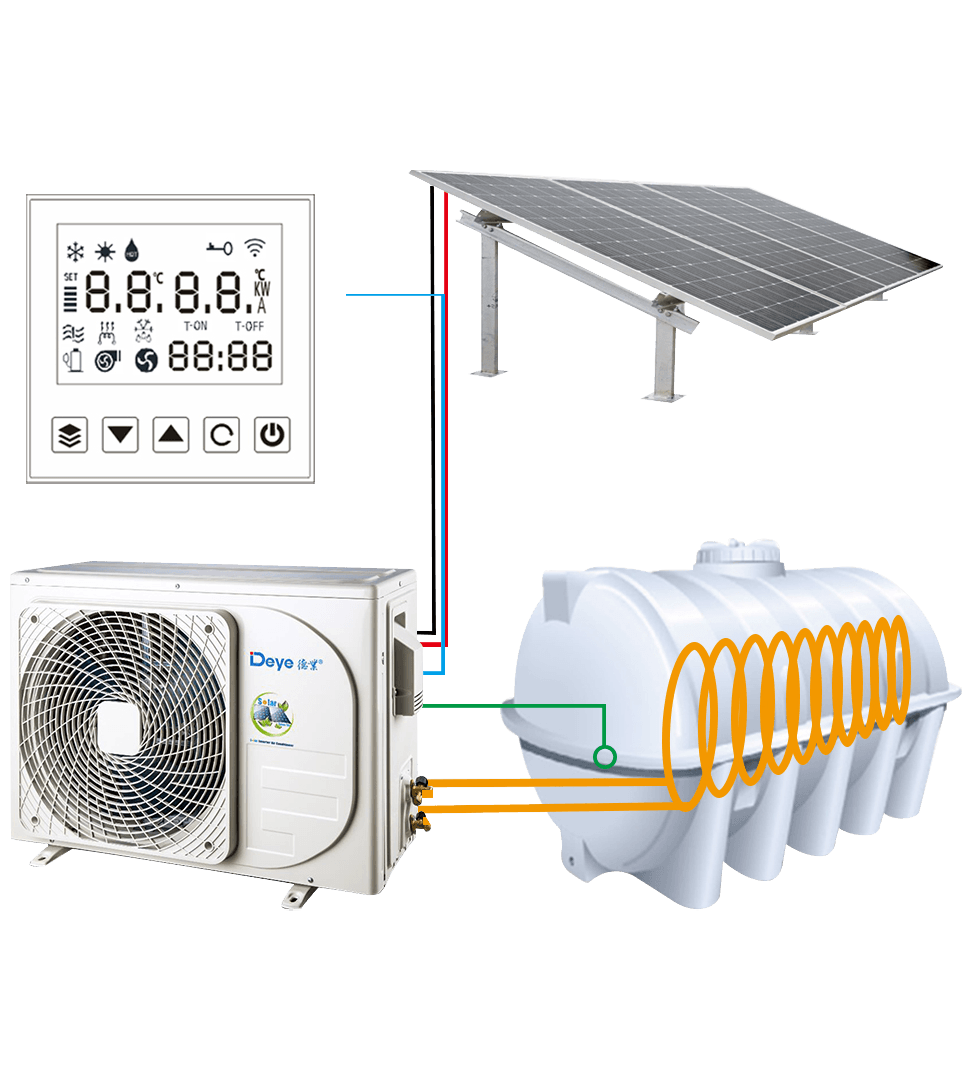
Why Direct Solar Cooling Matters
Air conditioning is often one of the largest electricity loads in a building. The load becomes especially expensive during summer afternoons, when electricity tariffs may be higher and grid stress may be severe. Solar generation usually peaks during these same hours. A conventional building uses grid electricity to run an AC air conditioner while solar panels may feed power through an inverter into the building or export it to the grid. Although this approach works, it usually requires a full solar inverter system, and if backup operation is desired, it may also require batteries and additional power-management equipment.
The Hybrid ACDC Solar Air Water Cooler uses a different principle. It accepts DC power directly from photovoltaic panels in series, with a DC input range of 80 V to 380 V and a maximum DC input current of 10 A. Recommended solar panel configurations vary by model: three to four 330 W panels in series for the 12K model, three to six 330 W panels for the 18K model, and three to eight 330 W panels for the 24K model. This arrangement allows the unit to use solar power directly for cooling or heating operation, reducing dependence on the AC grid.
During sunny daytime conditions, the unit can be driven only by solar panels, enabling very high daytime energy savings. When sunlight is not strong enough, AC/DC auto balance allows the system to supplement with grid power. The built-in AC grid power limiter can restrict grid consumption from 0 W to 600 W, helping users prioritize solar energy and control electricity cost. This function is especially important in applications where the user wants to avoid high grid draw but still maintain stable comfort.
For many users, the most attractive part of direct solar cooling is simplicity. A traditional solar-powered air-conditioning setup may include panels, a solar inverter, possibly a hybrid inverter, charge controller, battery bank, distribution equipment, and a conventional AC air conditioner. Each added component increases cost, installation time, heat generation, possible points of failure, and maintenance needs. The Hybrid ACDC Solar Air Water Cooler eliminates the requirement for an external inverter, battery, and charge controller, creating a more compact and direct energy path from PV modules to cooling output.
Product Architecture and Power Modes
The system supports three practical energy modes. The first is DC power mode, where solar panels directly power the unit. This is the preferred daytime mode when sufficient sunlight is available. Because the compressor and motors are full DC driven, the system can make efficient use of the photovoltaic source without converting DC solar power to AC and then back to DC internally. Fewer conversion steps generally mean less wasted energy and a cleaner system design.
The second mode is AC power mode. In this mode, the system operates from single-phase AC grid power rated at 208 V to 240 V and 50 Hz to 60 Hz. This ensures that the unit remains useful at night, during cloudy weather, or in buildings where users do not want to install solar panels immediately. For customers planning a staged energy upgrade, this flexibility is useful: the air conditioner can be installed and operated from the grid first, then connected to PV panels later.
The third mode is AC plus DC mixed power supply, also described as AC/DC Auto Balance. This mode is one of the product’s strongest advantages. Instead of switching abruptly between solar and grid power, the system can intelligently combine available solar energy with limited AC grid input. The grid power limiter allows the user to set AC draw between 0 W and 600 W. If solar irradiance changes due to clouds, shading, or time of day, the system can continue operation with supplemental grid input while maintaining the user’s preferred grid-consumption limit.
Compared with conventional solar air conditioners that rely heavily on batteries for stable operation, this mixed power strategy can reduce or eliminate battery dependence. Batteries increase system cost and require careful sizing, protection, ventilation, and eventual replacement. In hot climates, battery life can be shortened if thermal management is poor. A battery-free solar cooling solution avoids these complications for users whose main goal is daytime energy savings rather than nighttime off-grid cooling.
Core Advantages Over Conventional Competitors
The product’s first competitive advantage is its no-inverter, no-battery, no-charge-controller design. Many competitors require a separate solar inverter to convert PV DC power into AC power. Some require batteries to buffer solar fluctuations, while others need charge controllers for battery charging. These architectures can be effective, but they increase capital cost and system complexity. The Hybrid ACDC Solar Air Water Cooler integrates the required power-handling capability into the appliance itself, allowing direct PV connection within the specified voltage and current range.
The second advantage is the full DC-driven platform. DC-driven compressors and BLDC fan motors allow variable-speed operation, improved part-load efficiency, and smoother control compared with fixed-speed AC designs. Cooling demand is not constant throughout the day. A variable-speed system can reduce output when the room is close to set temperature and increase output when heat load rises. This saves energy and improves comfort by avoiding frequent start-stop cycles.
The third advantage is the AC grid power limiter. In many solar-assisted products, the grid simply supplies whatever energy the appliance requires when solar power is insufficient. This can undermine the goal of reducing grid consumption. By allowing AC power limitation from 0 W to 600 W, this system gives the user more control. For example, a user may set a low grid limit during peak tariff hours and allow the unit to rely mainly on solar input. This feature is also useful in weak-grid environments, where excessive air-conditioner load may cause voltage drops or breaker trips.
The fourth advantage is the wide operating temperature range. The unit is rated for operation from minus 10 degrees Celsius to 58 degrees Celsius and supports T3/T1 climate types. T3 conditions are especially demanding because outdoor temperatures can be extremely high. In such environments, ordinary cooling equipment may lose capacity or reliability. The product’s design focus on tropical operation makes it well suited to hot regions where solar radiation is strong and air-conditioning demand is high.
The fifth advantage is smart monitoring. WiFi control and app-based power metering allow users to monitor and manage operation more conveniently. For residential users, this improves daily comfort control. For commercial or facility managers, power visibility helps evaluate energy savings, detect unusual consumption patterns, and optimize operating schedules.
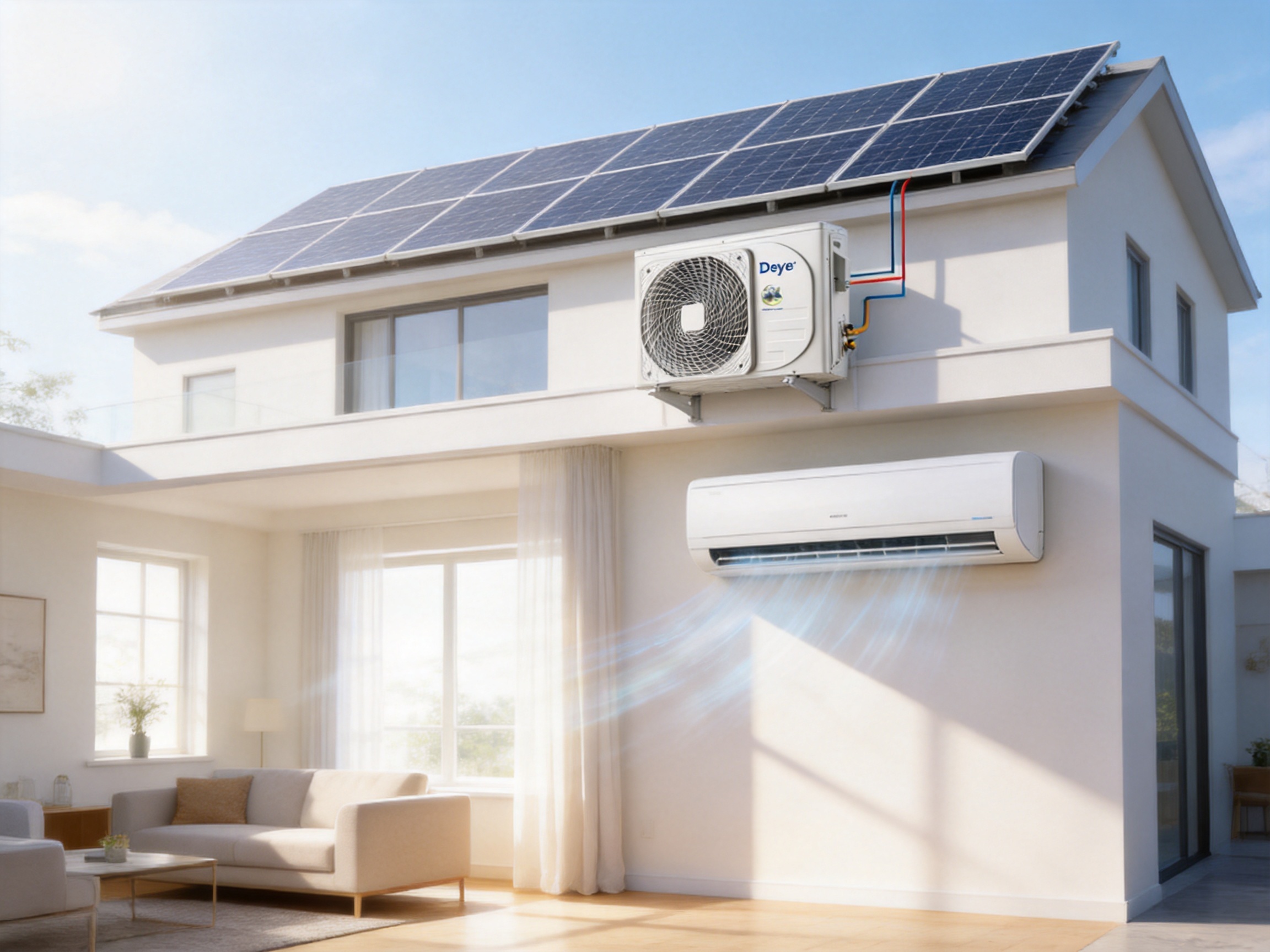
Technical Specification Overview
The following table summarizes key specifications for the three available models. Actual performance may vary depending on installation conditions, solar panel configuration, ambient temperature, room insulation, piping length, and usage pattern.
| Specification | DGA2-ACDCBLW-12K | DGA1-ACDCBLW-18K | DGA1-ACDCBLW-24K |
| Application Area | 12 to 20 square meters | 20 to 30 square meters | 30 to 42 square meters |
| AC Power Supply | 1 phase, 208 V to 240 V, 50 Hz to 60 Hz | 1 phase, 208 V to 240 V, 50 Hz to 60 Hz | 1 phase, 208 V to 240 V, 50 Hz to 60 Hz |
| DC PV Input Range | 80 V to 380 V | 80 V to 380 V | 80 V to 380 V |
| Maximum DC Current | 10 A or less | 10 A or less | 10 A or less |
| Recommended Solar Panels | 3 to 4 pieces of 330 W in series | 3 to 6 pieces of 330 W in series | 3 to 8 pieces of 330 W in series |
| Rated Cooling Capacity, T1 | 3510 W, 12,000 BTU | 5070 W, 17,300 BTU | 6450 W, 22,000 BTU |
| Cooling Power Input, T1 | 940 W nominal | 1400 W nominal | 1790 W nominal |
| Cooling Capacity, T3 | 2910 W, 9900 BTU | 4290 W, 14,700 BTU | 5130 W, 17,500 BTU |
| Heating Capacity | 4100 W, 14,000 BTU | 6100 W, 20,800 BTU | 7800 W, 26,600 BTU |
| T1 EER | 3.75 W/W, 12.75 BTU/W | 3.60 W/W, 12.35 BTU/W | 3.60 W/W, 12.30 BTU/W |
| T3 EER | 2.75 W/W, 9.45 BTU/W | 2.65 W/W, 9.00 BTU/W | 2.65 W/W, 9.00 BTU/W |
| COP | 3.50 W/W, 11.95 BTU/W | 3.45 W/W, 11.75 BTU/W | 3.40 W/W, 11.60 BTU/W |
| Indoor Air Flow | Up to 540 cubic meters per hour | Up to 980 cubic meters per hour | Up to 1290 cubic meters per hour |
| Outdoor Noise Level | 52 dB(A) or less | 55 dB(A) or less | 58 dB(A) or less |
| Refrigerant | R410A | R410A | R410A |
| Electronic Expansion Valve | Yes | Yes | Yes |
Model-by-Model Positioning
The 12K model is intended for smaller rooms, compact offices, bedrooms, guard rooms, small shops, and cabins in the approximate range of 12 to 20 square meters. With a nominal T1 cooling capacity of 3510 W and an application range that matches smaller spaces, it provides an efficient entry point for users who want solar-assisted cooling without oversizing the system. Its recommended PV configuration of three to four 330 W panels in series keeps the solar array compact and easier to install on limited roof space.
The 18K model expands the application range to approximately 20 to 30 square meters. It is suitable for medium bedrooms, small meeting rooms, retail spaces, workshops, and offices. With a T1 cooling capacity of 5070 W and heating capacity of 6100 W, it offers a strong balance of comfort output and solar compatibility. The recommended solar panel count of three to six 330 W panels allows flexibility depending on local solar conditions and user expectations for solar contribution.
The 24K model is the largest of the three, covering approximately 30 to 42 square meters. It is appropriate for larger living rooms, classrooms, open-plan offices, restaurants, equipment rooms, and commercial interiors. Its T1 cooling capacity reaches 6450 W, and its heating capacity reaches 7800 W. The recommended PV configuration of three to eight 330 W panels provides greater daytime energy supply for higher cooling loads. For buildings in sunny climates, this model can deliver substantial grid-energy reduction during peak heat hours.
Performance Under T1 and T3 Conditions
Air-conditioning performance should always be considered in relation to climate conditions. T1 performance reflects moderate climate test conditions, while T3 performance reflects hotter tropical conditions. A product may appear highly efficient under mild conditions but lose capacity and efficiency when outdoor temperatures rise sharply. This is why T3 data is particularly important for solar air-conditioning systems, which are often installed in hot, sunny regions.
The Hybrid ACDC Solar Air Water Cooler provides both T1 and T3 performance data. For the 12K model, rated cooling capacity under T1 conditions is 3510 W, while T3 cooling capacity is 2910 W. For the 18K model, T1 capacity is 5070 W and T3 capacity is 4290 W. For the 24K model, T1 capacity is 6450 W and T3 capacity is 5130 W. This transparent specification helps users select the right model for real-world heat conditions rather than relying only on nominal BTU class.
Energy efficiency is also documented under both climate types. T1 EER values range from 3.60 to 3.75 W/W, while T3 EER values are approximately 2.65 to 2.75 W/W. In hot climates, maintaining useful efficiency at high ambient temperatures is essential because the unit may operate for long hours. The combination of inverter compressor control, BLDC motors, electronic expansion valve, and direct solar input contributes to efficient operation across varying load conditions.
Comfort, Heating, and Dehumidification
Although the product is positioned strongly around solar cooling, it also provides heating capability. Heating capacity ranges from 4100 W on the 12K model to 7800 W on the 24K model. This makes the system useful beyond summer. In climates with cool mornings, mild winters, or shoulder seasons, heating mode can improve year-round value. The coefficient of performance values range from 3.40 to 3.50 W/W, indicating that the unit can deliver multiple units of heat output for each unit of electrical input under rated conditions.
Dehumidification is another important comfort function. High humidity makes indoor environments feel hotter and less comfortable even when the temperature is not extremely high. The three models provide dehumidification capacities of 1.3 L/h, 1.7 L/h, and 2.5 L/h respectively. This helps improve indoor comfort, protect furniture and equipment, and reduce the damp feeling common in tropical or coastal environments.
Indoor air flow is designed for the intended room size. The 12K model provides up to 540 cubic meters per hour, the 18K model up to 980 cubic meters per hour, and the 24K model up to 1290 cubic meters per hour. Multiple fan speeds allow the unit to balance cooling speed, noise, and comfort. Indoor turbo noise levels are specified at 42.5 dB(A) or less for the 12K model, 46 dB(A) or less for the 18K model, and 50 dB(A) or less for the 24K model.
Installation Simplicity and System Design
One of the main reasons users hesitate to adopt solar air conditioning is installation complexity. A conventional solar-plus-air-conditioning project may require coordination between HVAC installers, solar electricians, battery specialists, and grid-connection professionals. The Hybrid ACDC Solar Air Water Cooler reduces this complexity by integrating solar input capability directly into the air-conditioning system. The installer still must follow electrical safety rules, PV voltage limits, polarity requirements, grounding practices, and local codes, but the overall component chain is simplified.
The DC input range of 80 V to 380 V allows practical series connection of PV panels. The recommended 330 W panel counts provide a simple design reference. Because the system does not require a separate battery bank, installation can avoid battery cabinets, battery protection devices, and battery maintenance space. For many residential and light commercial users, this is a significant advantage because roof space may be available for panels while indoor utility space is limited.
Refrigerant pipe lengths are suitable for common split-system installations. Maximum refrigerant pipe length is 15 m for the 12K model, 20 m for the 18K model, and 25 m for the 24K model. Maximum level difference is 8 m for the 12K model and 10 m for the 18K and 24K models. These values provide flexibility for positioning indoor and outdoor units in apartments, villas, shops, and small commercial buildings.
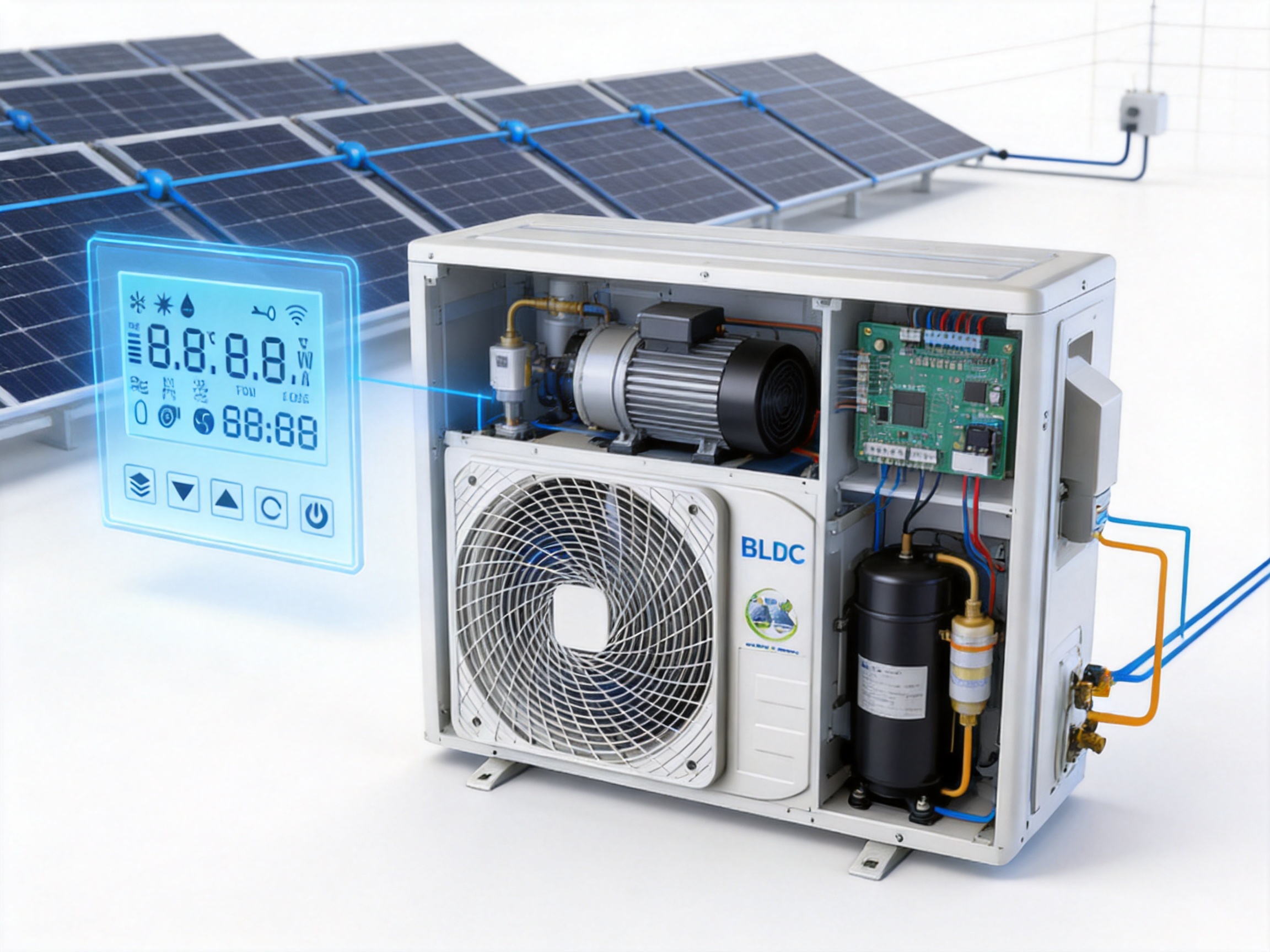
Smart Control and Power Visibility
WiFi control and app power metering are valuable because energy-saving equipment performs best when users can understand and adjust it. With app-based control, users can manage operating modes, schedules, and comfort settings more conveniently. With power metering, users can observe how the system consumes electricity and how solar contribution affects grid demand. This visibility is especially helpful for customers comparing energy bills before and after installation.
Power visibility also supports better behavior. For example, users may learn that pre-cooling a room during strong sunlight reduces later grid consumption. A shop owner may adjust cooling schedules to match business hours and solar generation. A household may set the grid power limiter lower during peak tariff periods and higher during low-cost periods. These operational choices can increase the financial benefit of the system without sacrificing comfort.
For facility owners managing multiple units, data-driven operation can reveal whether a unit is oversized, undersized, shaded, or poorly maintained. If solar input is unexpectedly low, the cause may be panel shading, dust, wiring issues, or incorrect orientation. If grid consumption is higher than expected, the room may have excessive heat gain, open doors, poor insulation, or an unsuitable set temperature. Monitoring helps convert a solar air conditioner from a passive appliance into an actively optimized energy asset.
Manufacturing Strength Behind the Product
A hybrid solar air-conditioning product requires more than ordinary HVAC assembly. It combines refrigeration technology, DC motor control, power electronics, solar input management, embedded software, protection logic, and user-interface design. The manufacturer’s background in photovoltaic inverters and energy storage systems provides a strong technical foundation for this kind of integrated product. Ningbo Deye Inverter Technology Co., Ltd. has built a product ecosystem that includes string inverters, hybrid inverters, microinverters, off-grid inverters, energy storage solutions, monitoring accessories, optimizers, EV chargers, and environmental appliances.
This cross-disciplinary experience matters because direct solar cooling is not simply an air conditioner with a PV label. The appliance must safely handle variable solar voltage, changing irradiance, grid supplementation, compressor load variation, and thermal protection. It must balance comfort performance with electrical stability. It must also meet user expectations for durability, low noise, and long warranty life. A company with established capabilities in solar power conversion and HVAC manufacturing is better positioned to solve these engineering challenges than a company focused on only one field.
Advanced manufacturing begins with research and design. Product engineers must define the DC input window, select appropriate compressors, design control boards, validate BLDC motor performance, match heat exchangers, and tune refrigerant flow control. The electronic expansion valve must respond precisely to load and temperature changes. The compressor control strategy must protect the system while maximizing efficiency. The AC/DC auto balance function must be stable under variable solar conditions.
Production quality is equally important. A high-quality split solar air-conditioning system requires accurate metal processing, consistent heat-exchanger manufacturing, reliable brazing, careful refrigerant circuit cleanliness, electronic board testing, insulation checks, leak detection, performance verification, and final inspection. Manufacturing discipline reduces early failure risk and improves long-term consistency between units. For export markets, packaging quality and logistics planning are also important because indoor and outdoor units must arrive safely after long transport routes.
Ningbo Deye’s broader manufacturing organization has experience serving customers in more than 140 countries and regions. This global exposure encourages product designs that consider different climates, grid conditions, installation practices, and customer expectations. Products intended for international markets must tolerate voltage variation, hot weather, transportation vibration, and diverse user habits. The Hybrid ACDC Solar Air Water Cooler reflects this global-use mindset through its wide operating temperature range, flexible AC power compatibility, and solar-first operating modes.
Quality Control and Reliability Considerations
Reliability is central to air-conditioning value. A cooling system often runs during the most uncomfortable and demanding hours of the day. If it fails during a heatwave, the user loses comfort, productivity, or even operational continuity. In solar cooling applications, reliability must cover both HVAC components and electrical control components. This product’s architecture supports reliability by reducing the number of external devices required. Fewer separate boxes and fewer conversion stages mean fewer installation interfaces where mistakes or failures may occur.
The compressor technology is a key reliability factor. The listed models use rotary inverter compressors, with compressor brands including Highly and Panasonic depending on model. Inverter compressor operation reduces frequent hard starts and allows smoother speed variation. BLDC indoor and outdoor fan motors also support efficient and controllable operation. Electronic expansion valves improve refrigerant management compared with simpler throttling devices, helping maintain performance across changing conditions.
Thermal design is also important. Outdoor units must reject heat effectively even when ambient temperature is high. The specified outdoor air flow values reach 2100 cubic meters per hour for the 12K model, 2200 cubic meters per hour for the 18K model, and 3300 cubic meters per hour for the 24K model. This airflow supports heat exchange under demanding conditions. Outdoor noise levels are controlled according to model capacity, remaining within specified limits.
Quality control should include leak testing, electrical insulation tests, controller function checks, pressure verification, refrigerant charge control, and performance inspection. For solar-input equipment, PV-side safety and control-board validation are especially important. Stable operation under different PV voltages and solar intensity levels helps ensure that the system performs reliably in real installations rather than only under laboratory conditions.
Energy-Saving Economics
The financial value of the Hybrid ACDC Solar Air Water Cooler depends on electricity price, solar resource, daily operating hours, installation cost, panel cost, room heat load, and user behavior. However, the general economic logic is clear. Air conditioners consume the most electricity when the sun is often strongest. By using solar panels directly during the day, the system can reduce grid energy consumption during the hours that may otherwise be most expensive.
The absence of mandatory batteries improves the economic case. Batteries are useful for backup and nighttime storage, but they add substantial cost. If the primary goal is daytime cooling, direct solar operation can provide a more cost-effective pathway. The user pays for the air-conditioning system and PV panels without necessarily purchasing battery capacity. The AC grid remains available as a backup or supplement, reducing the need to oversize the PV array for every weather condition.
The grid power limiter can further improve cost control. In regions with demand charges or weak electrical connections, limiting air-conditioner grid draw may help avoid high peaks. For small shops and offices, this may be particularly valuable. Instead of switching the air conditioner off during high-cost periods, users can continue cooling while restricting grid contribution and allowing solar power to carry most of the load.
Over time, savings can accumulate through reduced kWh consumption, reduced peak demand, and lower dependence on auxiliary solar equipment. Maintenance savings may also occur because there are fewer external energy components. The actual payback period should be calculated locally, but the product architecture is designed to reduce both energy consumption and balance-of-system cost.
Ideal Application Scenarios
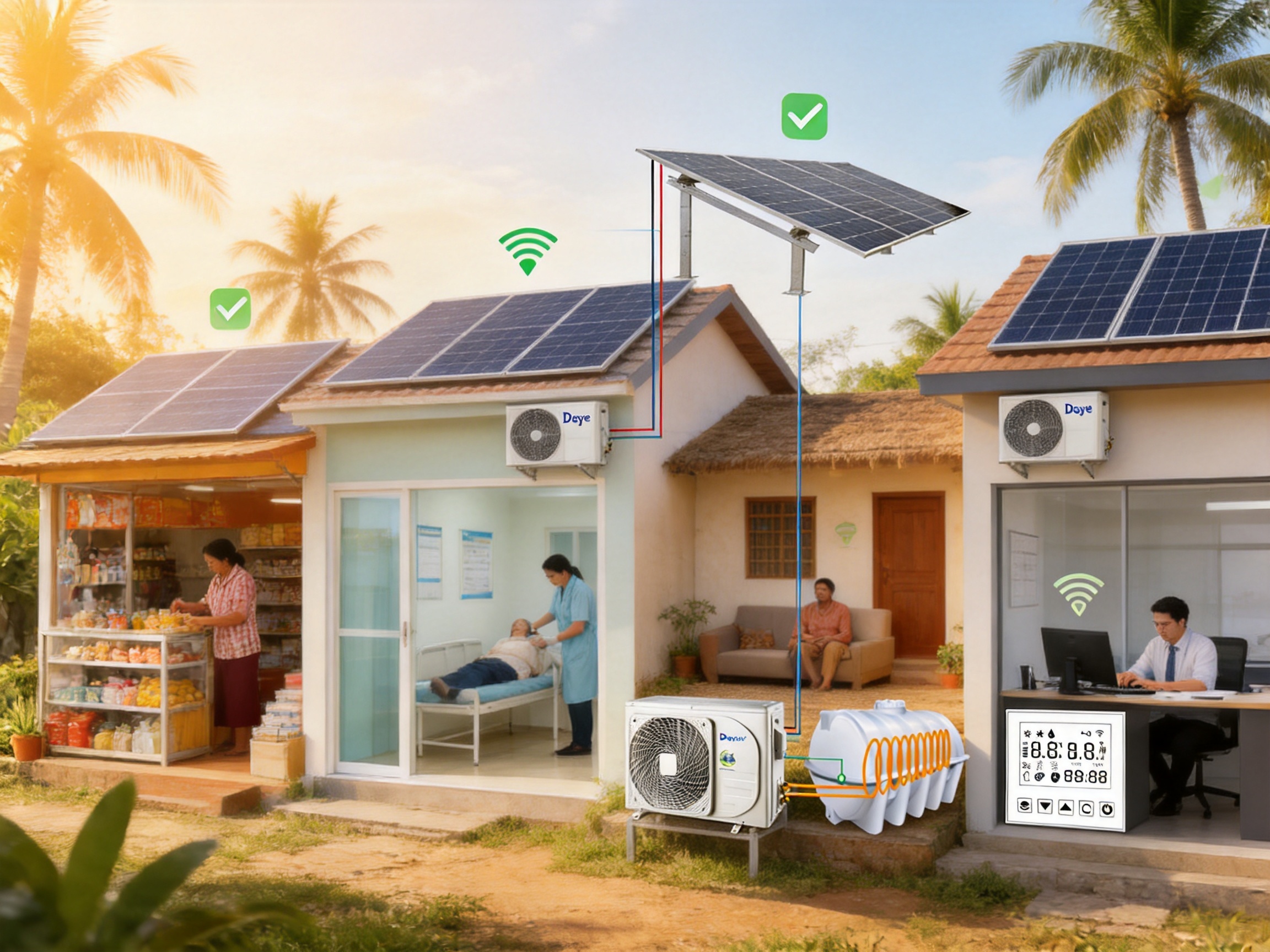
The product is well suited for sunny residential buildings where daytime cooling demand is high. Bedrooms, living rooms, home offices, and rental apartments can benefit from lower grid use without installing a full battery-based solar system. The system is also attractive for villas and rural homes with roof space for a small PV string.
Commercial applications include small shops, restaurants, salons, clinics, offices, classrooms, guard rooms, and farm facilities. Many of these spaces operate during daylight hours, matching the solar production profile. A store owner, for example, may run the air conditioner throughout the business day while using solar panels to reduce grid consumption. A clinic in a hot region may improve patient comfort while managing operating costs.
Remote and weak-grid locations are another strong fit. In areas where grid supply is unstable, the ability to prioritize solar energy and limit grid draw is helpful. The unit is not a complete off-grid energy system for all conditions, because it does not include batteries, but it can significantly reduce the stress placed on weak grid connections during sunny hours.
Hot-climate markets are especially suitable because the system is designed for tropical T3 conditions and outdoor temperatures up to 58 degrees Celsius. These are often the same regions with strong solar resources. The product therefore addresses both the energy source and the cooling challenge in a coordinated way.
Environmental and Sustainability Benefits
Cooling is essential for health, productivity, and comfort, but it can increase carbon emissions when powered by fossil-fuel electricity. A solar-driven air conditioner can reduce the carbon intensity of cooling by shifting a meaningful portion of energy consumption to photovoltaic generation. Because the Hybrid ACDC Solar Air Water Cooler can operate directly from PV panels during daytime, it helps align cooling demand with renewable energy availability.
The battery-free architecture also has environmental implications. Batteries require raw materials, manufacturing energy, transportation, safety management, and end-of-life recycling. While batteries are important in many energy systems, avoiding unnecessary battery capacity can reduce material use and lifecycle complexity. For users who mainly need daytime solar cooling, a direct PV solution may be a more resource-efficient option.
High efficiency contributes to sustainability as well. The combination of inverter compressor technology, BLDC fan motors, electronic expansion valve, and intelligent power balancing helps reduce wasted energy. Efficient dehumidification also improves comfort, allowing some users to set slightly higher temperatures while maintaining a comfortable indoor feel. Even small changes in set temperature can produce energy savings over long operating hours.
Comparison With Typical Alternatives
Compared with a standard grid air conditioner, the Hybrid ACDC Solar Air Water Cooler offers direct solar input and smart AC/DC balancing. A standard unit depends entirely on grid electricity unless connected to a separate solar power system. This means the user must either accept normal grid consumption or invest in a full PV system with inverter equipment. The hybrid solar unit integrates solar use directly into the appliance.
Compared with a conventional solar-plus-battery air-conditioning system, this product can reduce upfront cost and maintenance complexity. Battery systems are valuable when nighttime operation from stored solar energy is required, but they may not be necessary for users focused on daytime cooling. Eliminating the mandatory battery can make solar air conditioning more accessible and easier to deploy.
Compared with solar systems that use external inverters, the direct DC design can reduce conversion losses and simplify wiring architecture. Solar panels generate DC electricity. Many inverter-based systems convert this DC to AC, then the air conditioner’s internal electronics may convert AC back to DC for the compressor. Direct DC usage avoids unnecessary stages where possible.
Compared with basic DC air conditioners that lack grid support, this product offers greater usability. Pure DC systems may stop or reduce output sharply when sunlight is insufficient. The AC/DC auto balance function allows continued comfort by supplementing solar power with controlled grid input. This is a practical compromise between maximum solar use and daily comfort reliability.
Practical Selection Guidance
Selecting the right model begins with room size, but room size alone is not enough. Users should also consider ceiling height, wall insulation, window area, sun exposure, occupancy, equipment heat, local climate, and desired cooling speed. A small but poorly insulated room may need a larger model, while a larger shaded room with good insulation may perform well with a smaller unit.
The 12K model is best for compact spaces and users who want a smaller PV array. The 18K model is a balanced choice for medium areas. The 24K model is appropriate for larger rooms or higher heat loads. In very hot climates, T3 capacity should be considered carefully because cooling capacity decreases under extreme outdoor temperatures. Users should avoid selecting only by nominal BTU class without considering real ambient conditions.
Solar panel sizing should follow the recommended series configurations and local electrical rules. Panel voltage varies with temperature, irradiance, and model type, so installers must ensure that the PV string remains within the 80 V to 380 V input range and current does not exceed the specified limit. Proper orientation, tilt, ventilation, and shading avoidance improve solar performance. Even partial shading can reduce PV output, so panel placement is important.
For the best energy-saving result, users should combine good installation with good building practices. Sealing air leaks, using curtains or shading, improving insulation, keeping doors closed, cleaning filters, and maintaining outdoor airflow all reduce cooling load. A solar air conditioner performs best when the building envelope supports efficiency.
Manufacturing Innovation and Long-Term Value
The long-term value of this product is rooted not only in its feature list but also in the manufacturer’s ability to integrate multiple technical disciplines. Solar power electronics must be reliable. Refrigeration systems must be efficient. Motor drives must be smooth and durable. Control software must respond intelligently to changing solar and grid conditions. Manufacturing processes must ensure that every unit performs consistently.
Ningbo Deye Inverter Technology Co., Ltd. has developed extensive capabilities in solar inverter and energy storage technologies, with product ranges covering residential, commercial, industrial, and utility applications. This background supports advanced power-control knowledge that is directly relevant to AC/DC hybrid air-conditioning. The company’s environmental appliance experience further supports HVAC design, airflow management, refrigeration control, and user comfort.
A strong manufacturing base enables stable supply, repeatable quality, and continuous improvement. For distributors and project developers, this is important because product reliability affects reputation and after-sales cost. For end users, manufacturing strength means greater confidence that the product is supported by engineering experience, production scale, and service capability.
The company’s broader mission of promoting solar energy utilization and creating intelligent living environments aligns with this product category. Cooling is one of the most immediate energy challenges in warm regions. A direct solar air-conditioning product addresses that challenge in a practical way, making renewable energy visible and useful in daily life.
Frequently Asked Questions
What makes this solar air conditioner different from a normal air conditioner?
It can run directly from solar panels through a DC input while also supporting AC grid power. A normal air conditioner relies on AC electricity unless connected to a separate solar inverter system. This product integrates solar operation and AC/DC balancing into the appliance.
Does it require a battery?
No. The system is designed to operate without a battery. It can use solar power during the day and supplement with AC grid power when needed. This reduces system cost, space requirements, and battery maintenance.
Does it require an external solar inverter?
No. One of its main advantages is that it does not require an external inverter, battery, or charge controller for the specified direct PV operation. Solar panels can be connected within the approved voltage and current range.
Can it work at night?
Yes. At night, when solar power is not available, the unit can operate from single-phase AC grid power. The AC power supply specification is 208 V to 240 V, 50 Hz to 60 Hz.
What does AC/DC Auto Balance mean?
AC/DC Auto Balance means the system can combine available solar DC power with AC grid power. If sunlight is strong, solar power can carry the load. If sunlight weakens, grid power can supplement operation while the user controls grid input through the limiter.
What is the purpose of the AC grid power limiter?
The limiter allows AC grid draw to be restricted from 0 W to 600 W. This helps prioritize solar energy, reduce peak grid consumption, and manage electricity cost.
How many solar panels are recommended?
The 12K model is recommended with three to four 330 W panels in series. The 18K model is recommended with three to six 330 W panels in series. The 24K model is recommended with three to eight 330 W panels in series. Installers must confirm voltage and current compatibility with the selected panels.
Is the product suitable for very hot climates?
Yes. It is designed for T3/T1 climate types and supports operation up to 58 degrees Celsius. This makes it suitable for tropical and high-temperature regions where cooling demand and solar availability are both high.
Can it provide heating?
Yes. The models provide rated heating capacities of 4100 W, 6100 W, and 7800 W respectively, depending on model size. This extends usefulness beyond cooling season.
Who should consider this product?
It is suitable for homeowners, shops, offices, clinics, classrooms, small commercial buildings, rural facilities, and weak-grid locations that want solar-first cooling with grid backup and simplified installation.
Conclusion
The Hybrid ACDC Solar Air Water Cooler offers a practical response to one of the most important energy challenges in warm climates: how to provide reliable comfort while reducing grid electricity consumption. By allowing direct solar panel drive during daytime, supporting AC power when needed, and automatically balancing AC and DC energy sources, it delivers a flexible operating model that fits real-world conditions.
Its strongest advantages over many competitors are clear. It requires no external inverter, no battery, and no charge controller. It uses a full DC-driven design with inverter compressor technology, BLDC fan motors, electronic expansion valve, WiFi control, app power metering, and grid power limitation. It is designed for wide-temperature operation from minus 10 degrees Celsius to 58 degrees Celsius and provides documented T1 and T3 performance. The three model sizes allow users to match capacity to room requirements, from compact spaces to larger interiors.
The product is also supported by the manufacturing and engineering strengths of Ningbo Deye Inverter Technology Co., Ltd., a company with experience in photovoltaic inverters, energy storage systems, monitoring platforms, and environmental appliances. This combination of power-electronics knowledge and HVAC manufacturing capability is essential for a product that must manage solar input, grid supplementation, refrigerant performance, motor control, and user comfort in one integrated system.
For users seeking lower daytime energy costs, easier solar cooling adoption, reduced equipment complexity, and dependable comfort in hot climates, this Hybrid ACDC Solar Air Water Cooler represents a compelling solution. It turns sunlight into immediate cooling value, reduces dependence on conventional grid electricity, and supports a more efficient path toward sustainable indoor comfort.
References
ASHRAE Handbook: HVAC Systems and Equipment. American Society of Heating, Refrigerating and Air-Conditioning Engineers.
International Electrotechnical Commission. Standards for photovoltaic power systems and electrical safety practices.
International Energy Agency. Reports on cooling demand, building energy efficiency, and renewable electricity integration.
Solar Energy Engineering: Processes and Systems. Academic reference material on photovoltaic generation and solar energy applications.
Refrigeration and Air Conditioning Technology. Technical reference material on compressor systems, refrigerants, expansion devices, and heat exchange.
Manufacturer technical data for Hybrid ACDC Solar Air Water Cooler models DGA2-ACDCBLW-12K, DGA1-ACDCBLW-18K, and DGA1-ACDCBLW-24K.
Product: Hybrid ACDC Solar Air Water Cooler
PREV:Smart EV Charging for Solar-Powered Homes and Energy Systems
NEXT:Module-Level PV Optimization for Safer, Smarter, and Higher-Yield Solar Arrays
Share
Product recommendations
news recommendations
-
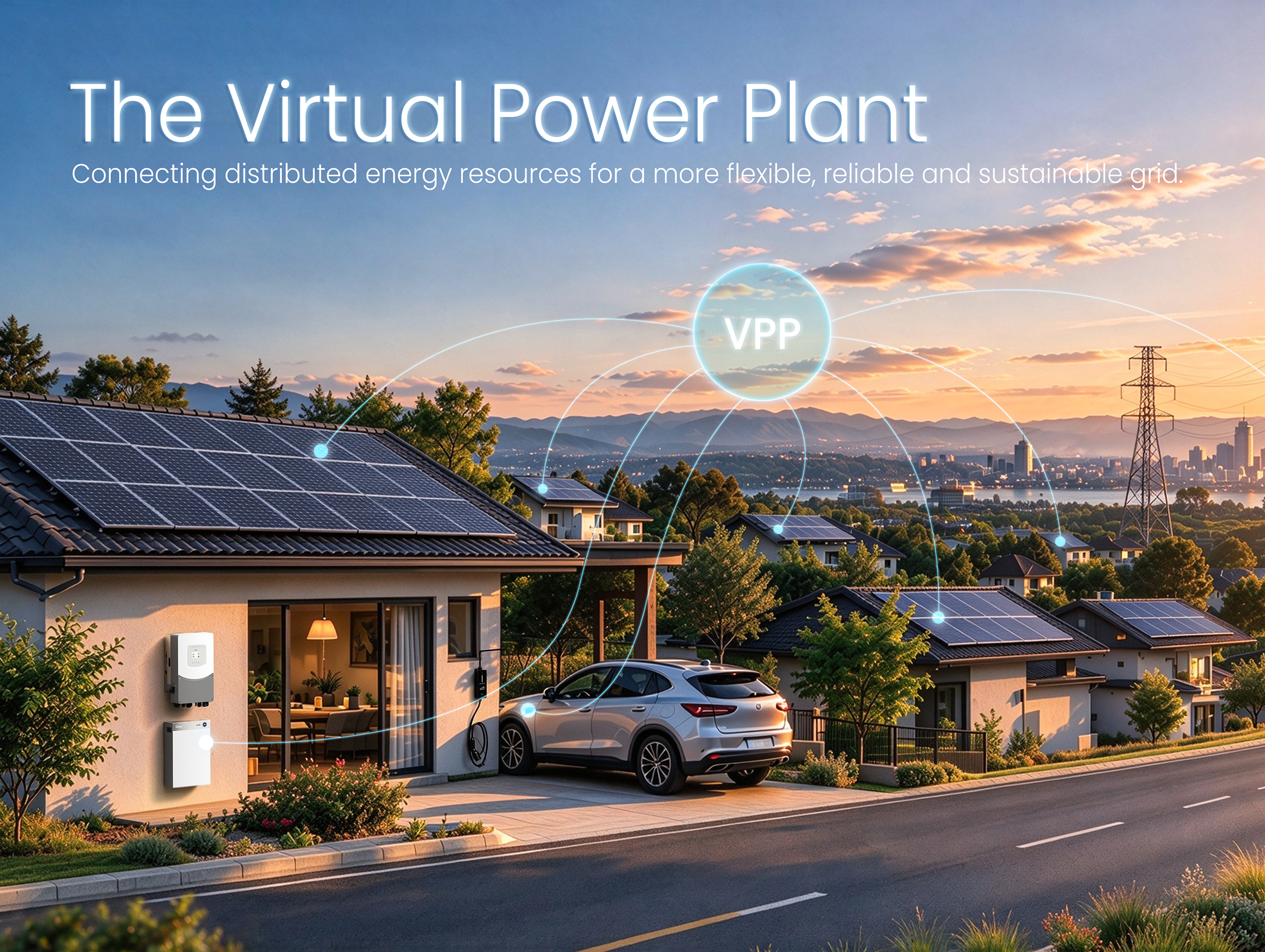 From Centralized Grids to Virtual Power Plants: The Next Evolution of the Power System
For more than a century, power systems around the world have relied on a centralized model. Large p...
-
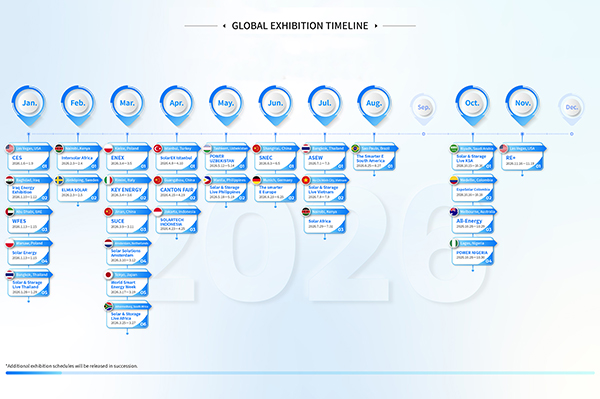 GLOBAL EXHIBITION TIMELINE
*Click to view larger image
-
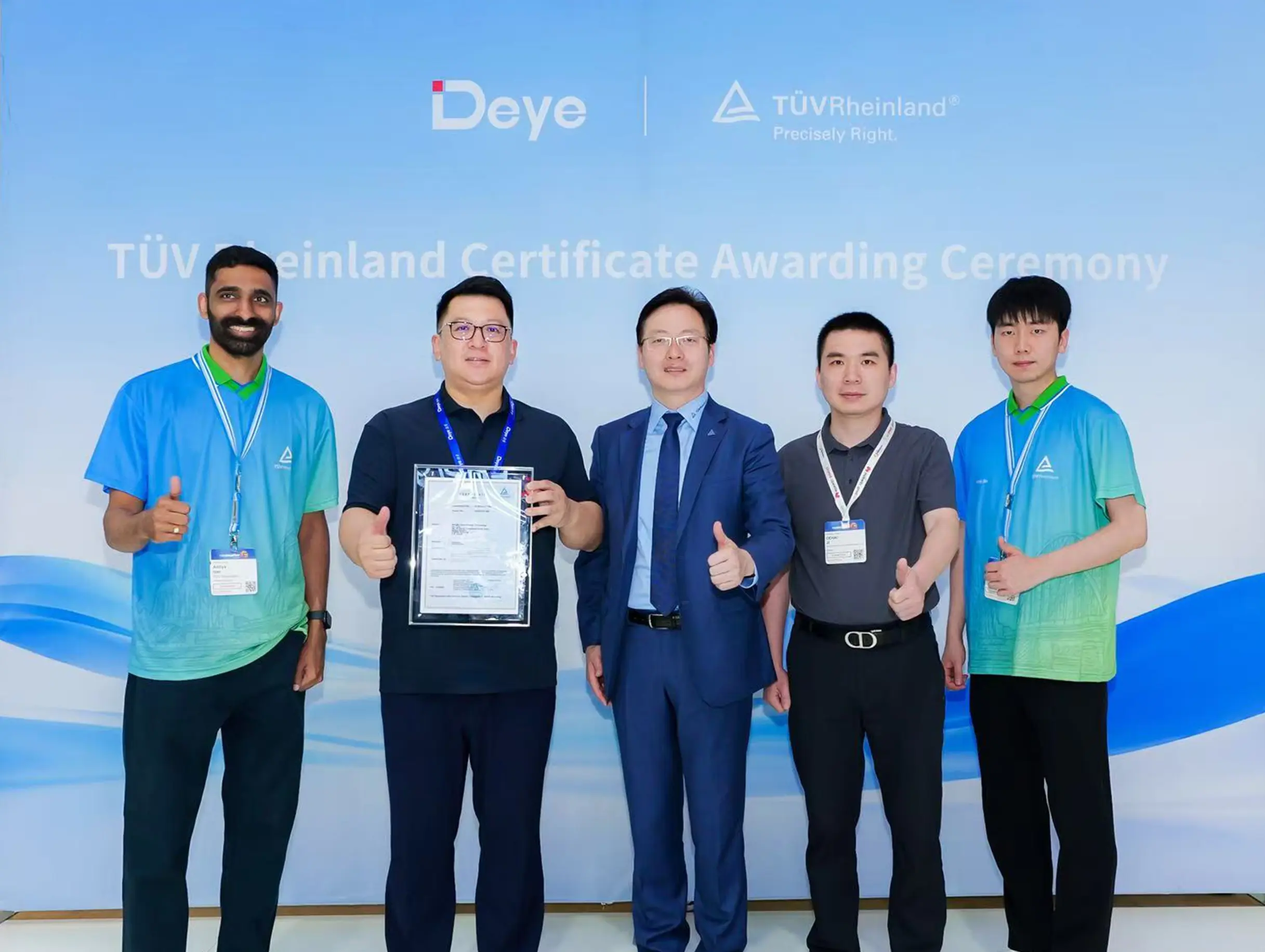 Deye Secures Multiple TÜV Rheinland Certifications at The smarter E Europe
On June 23, the opening day of The smarter E Europe 2026, Deye was officially awarded several presti...

Copyright@ 2024.Ningbo Deye Inverter Technology Co.,Ltd. All rights reserved. Solar Inverter Manufacturer
