
 Online Shop
 English
 China - 简体中文
 Global - English
 Brazil - Português
 Netherlands - Dutch
 Italy - Italiano
 Germany - Deutsch
 Spain - Español
 France - Français
 Vietnam - Tiếng Việt
 Poland - Polski
 Australia - English
 Japan - 日本語
Tan Meiling — Key Account Sales Executive, Hybrid Inverter & ESS

High-Voltage Split-Phase Hybrid Inverter for Japanese Residential Solar Storage
The SUN-4.95/5.5/8K-SG02HP2-JP-FM4 is a high-voltage split-phase hybrid inverter designed for solar power generation, battery energy storage, backup power, and grid interaction in residential and light commercial environments. With 4.95kW, 5.5kW, and 8kW power classes, four independent MPPT circuits, support for high-voltage batteries, and compatibility with 101V/202V split-phase three-wire electrical systems, it is engineered for markets that require stable grid-connected performance as well as dependable stand-alone operation.
This inverter series is especially suitable for users who want more than simple solar energy conversion. It supports grid-connected operation, off-grid backup, anti-reverse power flow control, high PV input capability, intelligent battery charging, and full-load or single-function operation. In practical terms, it helps households increase solar self-consumption, reduce grid dependence, improve energy security during outages, and manage power export according to local utility requirements.
Behind the product is the engineering and manufacturing capability of Ningbo Deye Inverter Technology Co., Ltd., a company with extensive experience in photovoltaic inverters, energy storage systems, microinverters, string inverters, off-grid systems, EV charging integration, monitoring platforms, and complete solar-plus-storage solutions. The product reflects a manufacturing philosophy based on electrical safety, thermal reliability, intelligent control, global certification compliance, scalable production, and long-term serviceability.
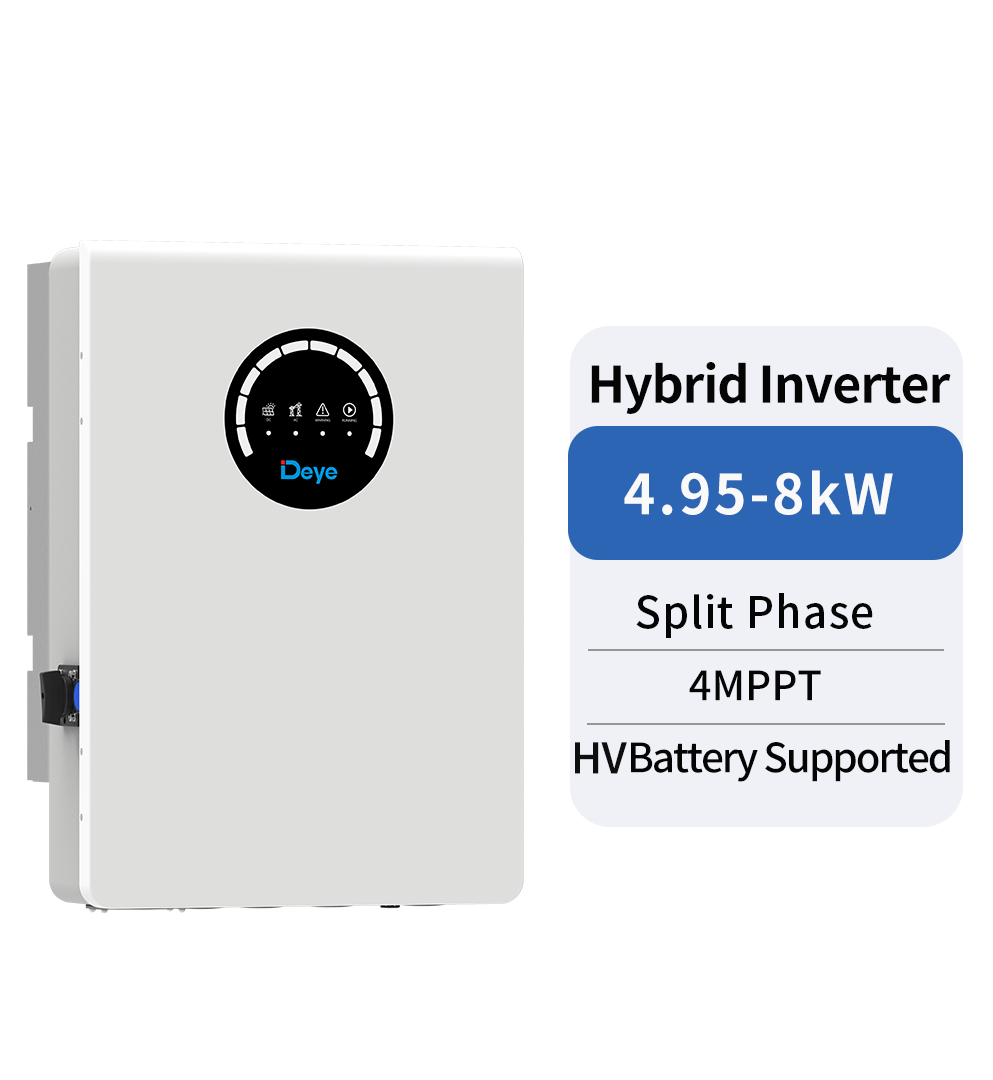
SUN-4.95/5.5/8K-SG02HP2-JP-FM4
Product Positioning and Core Application Value
The SUN-4.95/5.5/8K-SG02HP2-JP-FM4 is positioned as a hybrid inverter for users who require solar generation, battery storage, grid connection, and backup power in one integrated platform. Unlike traditional grid-tie inverters that shut down during utility outages unless paired with additional equipment, this hybrid inverter is equipped for both grid-connected and stand-alone operation. That means it can work with PV arrays, batteries, household loads, and the public grid to create a more flexible energy system.
The product is particularly relevant for split-phase residential electrical systems that use 101V and 202V loads. By supporting split-phase three-wire output, the inverter can serve mixed residential loads with a design that aligns with local electrical practices. This is a major advantage in applications where standard single-voltage inverter architectures may require extra balancing devices, transformers, or additional system design complexity.
The series includes three models: SUN-4.95K-SG02HP2-JP-FM4, SUN-5.5K-SG02HP2-JP-FM4, and SUN-8K-SG02HP2-JP-FM4. These models provide rated AC output active power of 4,950W, 5,500W, and 8,000W respectively. This allows installers and system designers to select a model according to the size of the PV system, battery capacity, load profile, backup requirements, and local interconnection limits.
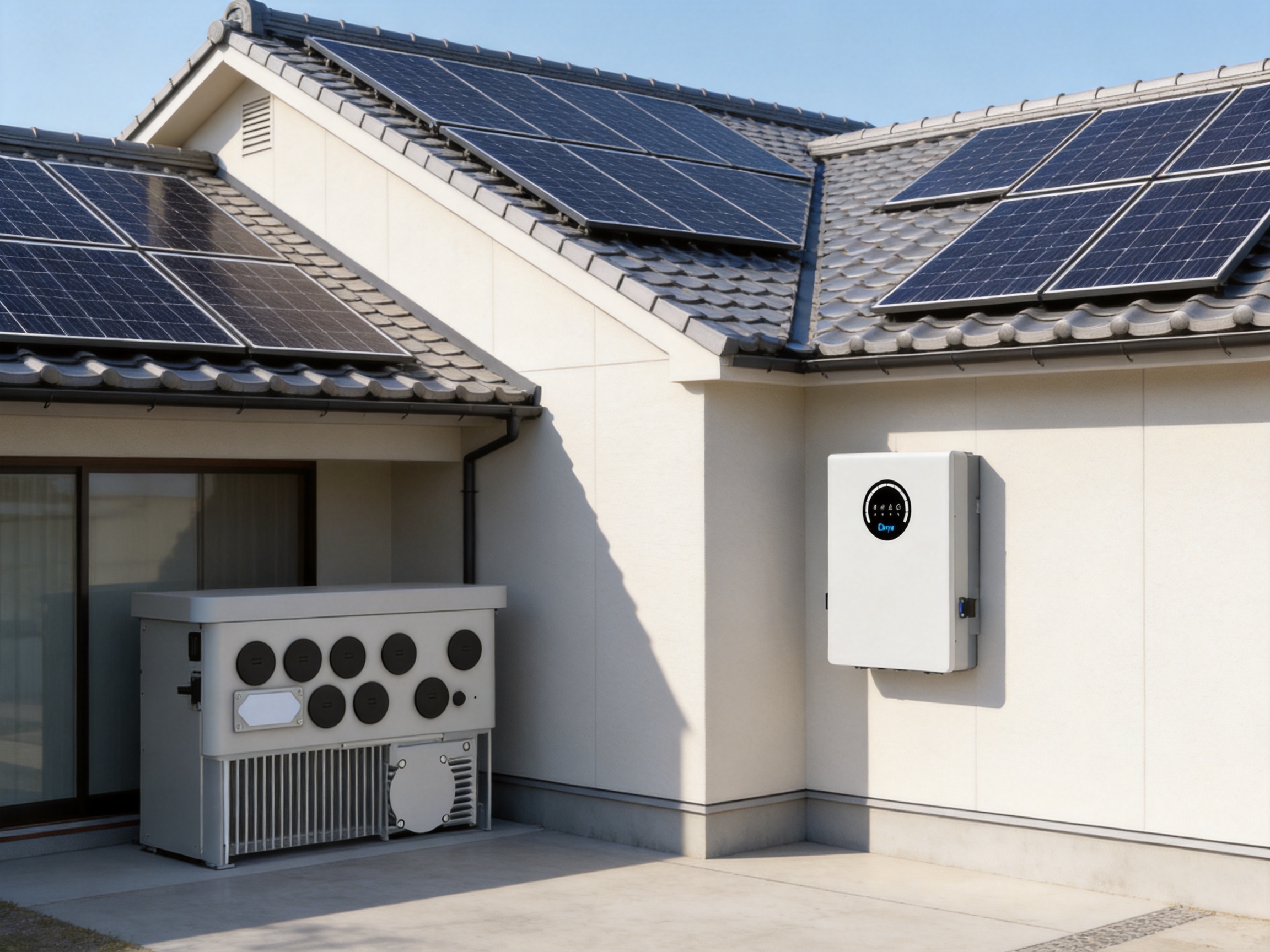
For homeowners, the practical value is simple: solar power can be used when the sun is shining, stored energy can be used at night or during peak electricity price periods, and backup power can support essential loads during grid interruptions. For installers, the value lies in simplified system architecture, high PV input flexibility, four MPPT channels, broad battery voltage compatibility, strong protection functions, and a robust IP65 enclosure for outdoor installation.
Key Technical Highlights
The inverter integrates several features that distinguish it from many competing hybrid inverter solutions. First, it supports high-voltage battery input with a battery voltage range of 80V to 500V. High-voltage battery systems can reduce current for the same power level, improving efficiency and helping reduce cable losses. The inverter supports lead-acid and lithium-ion batteries, and its battery charging method is self-adaptive to the battery management system, which is especially important for lithium battery safety and long-term reliability.
Second, the inverter offers four MPPT circuits, each with one string input. Many hybrid inverters in similar power categories offer only two MPPTs. Four MPPTs provide better design flexibility for rooftops with different orientations, shading conditions, module layouts, or string lengths. In real-world residential solar installations, roofs are rarely perfect. Different slopes, chimneys, dormers, trees, neighboring buildings, and seasonal shading can all reduce energy yield. Independent MPPT channels help each string operate closer to its optimum point, improving total system generation.
Third, the product supports high PV oversizing. The maximum DC allowable connected power is 10,000W for the 4.95kW model, 11,000W for the 5.5kW model, and 16,000W for the 8kW model. This supports solar array designs that can generate more energy during mornings, afternoons, cloudy days, and winter months. Proper PV oversizing can improve annual energy production and increase battery charging opportunities without necessarily increasing inverter AC output beyond permitted levels.
Fourth, the inverter includes anti-reverse power flow measures. In regions where utilities restrict or prohibit energy export to the grid, anti-reverse control is essential. It allows the system to prioritize local consumption and battery charging while limiting unwanted backfeed. This gives users more compliance flexibility and helps installers meet utility interconnection requirements.
Fifth, the product provides a maximum continuous AC bus pass-through current of 80A from grid to load. This strong pass-through capability allows the inverter to support household loads through the AC bus when the grid is available, reducing the need for oversized external transfer equipment in many system designs. In backup-oriented systems, pass-through capacity is an important practical specification because it affects how seamlessly the inverter can integrate with household load panels.
Specification Overview
The following table summarizes selected specifications of the SUN-4.95/5.5/8K-SG02HP2-JP-FM4 series. It is intended as an accessible overview for system designers, installers, distributors, and end users evaluating the product for solar-plus-storage applications.
| Item | SUN-4.95K-SG02HP2-JP-FM4 | SUN-5.5K-SG02HP2-JP-FM4 | SUN-8K-SG02HP2-JP-FM4 |
| Rated AC Output Active Power | 4,950W | 5,500W | 8,000W |
| Maximum AC Output Apparent Power | 5,440VA | 6,050VA | 8,800VA |
| Rated AC Output Current | 24.6A | 27.3A | 39.7A |
| Battery Type | Lead-acid or lithium-ion | Lead-acid or lithium-ion | Lead-acid or lithium-ion |
| Battery Voltage Range | 80V to 500V | 80V to 500V | 80V to 500V |
| Maximum Charging Current | 50A | 50A | 50A |
| Maximum Discharging Current | 50A | 50A | 50A |
| Maximum DC Allowable Connected Power | 10,000W | 11,000W | 16,000W |
| Maximum DC Input Power | 8,000W | 8,800W | 12,600W |
| Maximum DC Input Voltage | 500V | 500V | 500V |
| MPPT Voltage Range | 50V to 450V | 50V to 450V | 50V to 450V |
| Number of MPPT Circuits | 4 | 4 | 4 |
| Electrical System | Split-phase three-wire, 101V/202V | Split-phase three-wire, 101V/202V | Split-phase three-wire, 101V/202V |
| Protection Rating | IP65 | IP65 | IP65 |
| Cooling Method | Natural air cooling | Natural air cooling | Natural air cooling |
| Warranty Period | Standard 10 years, extended warranty available | Standard 10 years, extended warranty available | Standard 10 years, extended warranty available |
Four MPPT Circuits: A Major Advantage in Real Rooftop Conditions
One of the strongest competitive advantages of this inverter series is the inclusion of four MPPT circuits. Maximum Power Point Tracking is the control process that enables a PV string to operate at the voltage and current combination that produces maximum power. When all modules in a string experience the same irradiance, temperature, and orientation, tracking is relatively simple. In real installations, however, conditions vary constantly.
A rooftop may have east-facing and west-facing arrays. One section may be shaded in the morning while another receives full sun. A smaller roof plane may require a shorter string, while a larger roof plane supports a longer string. If these different strings are forced onto one or two MPPT channels, the energy yield can be compromised because the inverter must find a common operating point that may not be ideal for every string.
With four MPPT circuits, the SUN-4.95/5.5/8K-SG02HP2-JP-FM4 gives installers more freedom. Each string can be assigned to its own MPPT, reducing mismatch losses and making the system easier to design around complex rooftops. This is especially useful in densely built residential areas where roof shapes are irregular and shading changes throughout the day.
Compared with many competing hybrid inverters that provide fewer MPPT channels, this product can better preserve energy yield without requiring module-level electronics on every panel. While optimizers and microinverters have their own advantages in some projects, a four-MPPT hybrid inverter can offer an efficient balance between design flexibility, cost control, and centralized system management.
The PV input current rating of 20A per input and maximum short-circuit current of 30A per input also help the inverter adapt to modern PV modules with higher current characteristics. As module power ratings continue to increase, inverter input current capacity becomes more important. A low input current limit can restrict module selection or force less efficient string layouts. This series is designed to accommodate contemporary PV system requirements.
High-Voltage Battery Support and Intelligent Energy Storage
The battery input range of 80V to 500V allows the inverter to work with high-voltage storage systems while retaining compatibility with different battery chemistries, including lead-acid and lithium-ion. In modern residential solar storage, lithium-ion batteries are increasingly common because of their energy density, cycle life, and intelligent battery management features. At the same time, compatibility with lead-acid batteries can be useful in certain replacement, budget-sensitive, or specialized applications.
The inverter uses a battery charging method that is self-adaptive to the battery management system. This is important because modern lithium batteries rely on communication between the inverter and the BMS to coordinate charging voltage, charging current, discharge limits, state of charge, temperature protection, and fault responses. A well-integrated inverter-battery relationship can improve safety, reduce unnecessary stress on the battery, and enhance overall system life.
The maximum charging and discharging current is 50A. In a high-voltage architecture, this current rating can support meaningful power flow while keeping conductor size and losses under control. Compared with low-voltage battery systems, high-voltage systems can be more efficient at higher power levels because current is lower for equivalent power transfer. Lower current can reduce heat generation and improve system performance when properly designed.
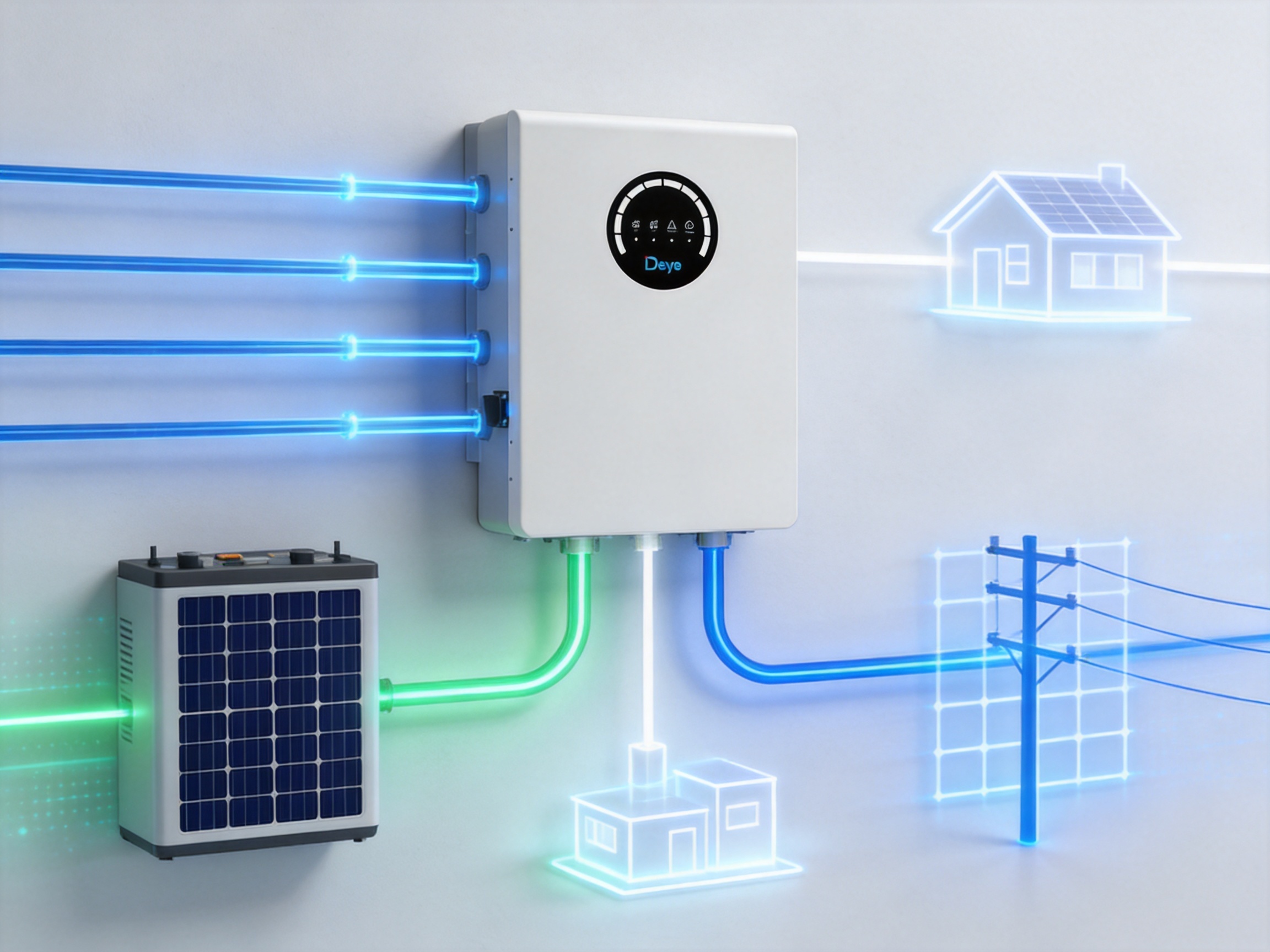
For end users, the battery interface means solar energy does not have to be consumed only when it is generated. Excess daytime PV power can charge the battery. In the evening, stored energy can support household loads. During power outages, the battery can help maintain selected loads, depending on system configuration and available stored energy. In areas with time-of-use tariffs, the inverter can also form part of a strategy for shifting energy consumption away from high-price periods.
Grid-Connected and Stand-Alone Operation
The ability to operate in both grid-connected and stand-alone modes is central to the product’s value. In grid-connected mode, the inverter synchronizes with the utility grid and manages solar generation, battery charging, battery discharging, load supply, and export limitation according to system settings. In stand-alone operation, the inverter can provide power to loads when the grid is unavailable, using energy from PV and batteries.
This dual-mode capability differentiates hybrid inverters from conventional on-grid inverters. A standard grid-tie inverter normally shuts down when the grid fails, even if there is sunlight, because anti-islanding rules prevent uncontrolled energizing of utility lines. A hybrid inverter with backup capability can isolate from the grid and continue supplying designated loads, provided the battery and PV conditions support operation.
The SUN-4.95/5.5/8K-SG02HP2-JP-FM4 also provides peak power in off-grid conditions equal to 1.5 times rated power for 10 seconds. This is useful because certain household loads require higher starting current than running current. Pumps, refrigerators, compressors, and motor-driven appliances can create short surge demands. The peak power capacity helps the inverter handle temporary load spikes, improving real-world backup usability.
The rated output voltage is 101/202V with an allowable operating range of 0.85Un to 1.1Un. Rated frequency support covers both 50Hz and 60Hz systems, with frequency ranges of 45Hz to 55Hz and 55Hz to 65Hz respectively. The split-phase three-wire electrical system supports both 101V and 202V loads, making the product suitable for applications that require this dual-voltage residential architecture.
Anti-Reverse Power Flow for Utility Compliance
Anti-reverse power flow control is an increasingly important feature in solar installations. Some utilities limit export capacity, require zero-export operation, or enforce specific interconnection rules to protect distribution networks. Without export control, a PV system may feed excess energy back to the grid during periods of low household consumption and high solar production.
The SUN-4.95/5.5/8K-SG02HP2-JP-FM4 includes anti-reverse power flow measures to help manage this challenge. In a properly configured system, the inverter can reduce or redirect excess PV generation to local loads or batteries, limiting unwanted export. This can simplify approval in regions where reverse power flow is restricted and can help users maximize self-consumption rather than sending energy away at low or uncertain compensation rates.
Compared with competitors that require additional external control hardware for basic export limitation, integrated anti-reverse capability can reduce system complexity. It can also improve response coordination because the inverter itself participates directly in power management. For installers, this means fewer compatibility concerns and more predictable system behavior.
Electrical Protection and Safety Architecture
Hybrid inverters must manage power from multiple sources: PV strings, batteries, the grid, and backup loads. This makes protection architecture extremely important. The SUN-4.95/5.5/8K-SG02HP2-JP-FM4 integrates a broad set of protection functions, including DC reverse polarity protection, AC output overcurrent protection, overheat protection, AC output overvoltage protection, AC output short-circuit protection, DC component detection, overvoltage load reduction protection, ground fault current detection, islanding detection, ground fault detection, DC input switch, DC terminal insulation resistance detection, residual current detection, and surge protection.
Arc fault circuit interrupter functionality is optional, providing an added layer of PV-side safety where required or preferred. Arc faults can occur due to damaged connectors, poor terminations, insulation issues, or mechanical stress. Detecting and interrupting abnormal arcing can reduce fire risk and improve system safety.
The inverter’s current harmonic distortion is less than 3%, and the grid DC component is less than 0.5% of rated current. These figures are important because grid-connected equipment must deliver power with acceptable quality. Low harmonic distortion helps reduce stress on electrical equipment and supports stable grid interaction.
The power factor adjustment range from 0.8 leading to 0.8 lagging allows reactive power support according to grid requirements. In modern distributed energy systems, inverters are often expected to do more than inject active power. They may also participate in voltage regulation or power quality management through reactive power control. This inverter’s adjustment range supports such grid service requirements.
Thermal Design, IP65 Protection, and Natural Air Cooling
The inverter is rated for an operating temperature range from -40℃ to +60℃, with derating above 45℃. This wide operating range indicates suitability for challenging outdoor and indoor environments. Inverters are often exposed to seasonal extremes, rooftop heat, cold utility rooms, garages, coastal humidity, and variable installation conditions. A broad temperature specification gives installers more flexibility and users greater confidence.
The IP65 dust and water protection rating makes the inverter suitable for outdoor installation when installed according to applicable instructions and local codes. IP65 protection means the enclosure is designed to prevent dust ingress and resist water jets, helping protect internal components from environmental exposure. This is a significant advantage over products with lower ingress protection that may require more sheltered installation locations.
Natural air cooling is another notable feature. Unlike fan-cooled systems, natural cooling has no fan as a moving wear component. This can reduce maintenance needs, minimize noise, and improve long-term reliability. The specified noise level is no more than 50dB, suitable for residential environments where acoustic comfort matters.
Thermal management is not simply a matter of adding a heat sink. It requires careful electronic layout, component selection, thermal interface design, enclosure engineering, and control algorithms that protect components under varying loads. By combining natural air cooling with derating logic and overheat protection, the product is designed to operate dependably while reducing mechanical complexity.
Advantages Over Competing Hybrid Inverters
The hybrid inverter market is crowded, but the SUN-4.95/5.5/8K-SG02HP2-JP-FM4 offers several advantages that make it highly competitive. The first advantage is its combination of split-phase 101/202V output and high-voltage battery support. Some competing products may support storage but are not optimized for this electrical system. Others may support split-phase output but rely on low-voltage batteries that require higher current and heavier cabling. This series combines both attributes in a single platform.
The second advantage is four independent MPPT circuits. In the same power range, many alternatives offer two MPPTs, limiting rooftop design flexibility. Four MPPTs reduce mismatch risk and can improve energy yield in complex installation environments. This is especially valuable in residential markets where aesthetics, roof geometry, and shading constraints often prevent ideal PV layouts.
The third advantage is high PV input flexibility. With maximum DC allowable connected power up to 16,000W on the 8kW model, the inverter enables designers to oversize PV arrays for improved annual generation. Solar production rarely stays at peak output for long, so responsible oversizing can produce more usable energy across the day and across seasons. This can improve battery utilization and reduce grid imports.
The fourth advantage is the 80A continuous AC bus pass-through current. Pass-through capability is a practical specification that directly affects system integration. A strong pass-through rating can reduce limitations on connected loads and help create a more seamless household power architecture.
The fifth advantage is the robust protection package. Integrated protections reduce reliance on external devices for basic operational safety and improve coordinated response to abnormal conditions. When a hybrid inverter manages PV, battery, grid, and load circuits, built-in protection intelligence is essential.
The sixth advantage is quiet, fanless natural cooling. Some competing inverters rely on active fans, which can introduce noise, maintenance requirements, and long-term reliability concerns. Natural air cooling supports residential comfort and reduces wear-prone moving parts.
The seventh advantage is the standard 10-year warranty with extended warranty availability. A long warranty period signals confidence in design, component quality, and manufacturing consistency. For homeowners investing in a long-life solar-plus-storage system, warranty coverage is a crucial purchasing factor.
Advanced Manufacturing Strengths Behind the Product
Ningbo Deye Inverter Technology Co., Ltd. benefits from the broader technological and manufacturing foundation of a comprehensive enterprise established in 2000 and listed on the Shanghai Stock Exchange in 2021. The company has developed strong capabilities across solar inverters, energy storage systems, environmental appliances, and intelligent energy solutions. Its products are sold in more than 140 countries and regions, reflecting international market experience and large-scale operational capacity.
Advanced inverter manufacturing requires much more than assembly. It begins with research and development in power electronics, embedded control, grid compliance, thermal engineering, electromagnetic compatibility, battery communication, mechanical protection, and cloud monitoring. The company’s broad product portfolio, including string inverters, hybrid inverters, off-grid inverters, microinverters, ESS solutions, PV optimizers, EV chargers, and monitoring accessories, supports cross-platform learning. Lessons from one product family can strengthen another.
In production, high-quality inverter manufacturing typically involves automated circuit board assembly, precision soldering, component traceability, conformal coating or protective treatment where required, high-voltage insulation checks, functional testing, firmware calibration, thermal verification, aging tests, and final quality inspection. For a hybrid inverter, testing must verify PV input behavior, battery communication, AC output stability, grid synchronization, protection responses, power conversion efficiency, communication interfaces, and safety shutdown logic.
Manufacturing process control is particularly important for high-voltage equipment. Creepage distance, clearance distance, insulation material quality, connector reliability, torque control, heat dissipation contact, and enclosure sealing all affect long-term safety. A mature factory must control these details consistently at scale. The product’s IP65 rating, wide temperature range, natural cooling design, and integrated protections all depend on disciplined engineering and manufacturing execution.
The company’s scale advantage also contributes to supply chain stability. Inverter production depends on semiconductors, capacitors, inductors, relays, sensors, microcontrollers, communication modules, connectors, enclosures, and protection devices. A manufacturer with established purchasing, incoming quality control, supplier auditing, and inventory planning can better maintain consistent product quality and delivery reliability.
Another strength is system-level capability. The company is not limited to one inverter type. It offers residential all-in-one energy storage solutions, commercial and industrial battery cabinets, modular ESS solutions, PV-BESS-EV charging integrated solutions, and utility-scale liquid-cooled energy storage systems. This broad solution experience helps engineers understand how hybrid inverters must behave inside complete energy ecosystems, not only as standalone conversion devices.
Engineering for Installation Efficiency
Installers evaluate inverters not only by electrical specifications but also by installation practicality. The SUN-4.95/5.5/8K-SG02HP2-JP-FM4 has dimensions of 423mm by 570mm by 256.5mm, excluding connectors and bracket, and weighs 32kg. This size and weight reflect a robust enclosure and power electronics platform while remaining manageable for professional installation teams.
The four-string, four-MPPT design simplifies PV wiring decisions because each string can be independently tracked. The DC input switch and integrated protection features support safer commissioning and maintenance procedures. The split-phase three-wire output helps align the inverter with 101V/202V load requirements, reducing the need for additional conversion steps in suitable systems.
High-voltage battery compatibility can also support cleaner installations. Because power can be transferred at lower current than comparable low-voltage systems, cable requirements can be optimized when matched with the correct battery architecture and installed according to applicable standards. This may reduce voltage drop, heat, and installation complexity.
The IP65 enclosure gives installers more placement flexibility. In residential projects, finding a protected indoor equipment area is not always easy. Outdoor-rated equipment can simplify layout, although proper shading, ventilation, service clearance, and code compliance remain important. Natural cooling further reduces the need to account for fan airflow paths and fan noise.
Energy Management and Monitoring Value
Modern solar-plus-storage systems are increasingly digital. Users want to understand how much solar energy they generate, how much power they consume, when batteries charge and discharge, and how much grid energy they import or export. Installers and service teams need remote visibility to diagnose faults, update settings, and optimize performance.
The company has developed an energy IoT ecosystem supported by cloud-based monitoring and intelligent energy management. While the specific monitoring configuration may vary by installation and accessory selection, the broader ecosystem is important because hybrid inverters are no longer isolated electrical appliances. They are nodes in a connected energy network.
Energy monitoring helps homeowners make better decisions. If the system shows that batteries are fully charged by midday and excess solar is curtailed due to zero-export settings, the homeowner may choose to shift appliance usage to daylight hours. If evening consumption drains the battery too quickly, the user may adjust load behavior or consider increasing storage capacity. If generation drops unexpectedly, monitoring data can alert the installer to possible shading, soiling, wiring, or equipment issues.
For service teams, remote monitoring reduces unnecessary site visits. Many support issues can be diagnosed by reviewing operating data, error codes, grid voltage events, battery communication status, or PV string behavior. This improves customer satisfaction and lowers service costs.
Reliability Through Protection, Certification, and Quality Control
The product’s certification includes S-JET, an important indicator for the target market. Certification is not merely a label; it reflects compliance with relevant safety and performance requirements. For installers and end users, certified equipment helps reduce approval risk and supports confidence in electrical safety.
Reliability is built through multiple layers. The first layer is design reliability: selecting suitable components, designing adequate thermal paths, protecting against abnormal voltages and currents, and writing stable control firmware. The second layer is manufacturing reliability: consistent assembly, quality inspection, and testing. The third layer is operational reliability: protective functions, derating behavior, monitoring, and service support.
The inverter topology is non-isolated, which is common in high-efficiency modern inverter designs. Non-isolated topology can improve conversion efficiency and reduce size and weight, but it requires careful protection design, insulation monitoring, grounding logic, and compliance with safety standards. The integrated DC terminal insulation resistance detection, residual current detection, and ground fault detection are therefore important elements of the system’s safety architecture.
Overvoltage category OVC II for DC and AC, surge protection level Type III, and a comprehensive protection set show that the inverter has been designed with environmental electrical stress in mind. In field installations, equipment may experience grid disturbances, switching transients, lightning-induced surges, wiring faults, temperature extremes, and load abnormalities. Robust protection is essential for long service life.
Use Scenarios
The first common use scenario is solar self-consumption. In this configuration, PV panels produce electricity during the day, household loads consume solar power directly, and excess energy charges the battery. In the evening, the battery discharges to supply household loads. This reduces grid imports and improves the economic value of solar generation.
The second scenario is backup power. When the grid fails, the inverter can operate in stand-alone mode and supply connected loads from the battery and available PV energy. The 1.5-times peak power capability for 10 seconds improves the ability to handle temporary surge loads. The actual backup duration depends on battery capacity, load size, weather, and system configuration.
The third scenario is zero-export or limited-export operation. With anti-reverse power flow measures, the system can be configured to limit energy sent to the grid. This is useful where grid export is not allowed, where export compensation is unattractive, or where utility interconnection rules require strict control.
The fourth scenario is complex rooftop PV design. With four MPPT circuits, the inverter can handle multiple roof planes or strings with different irradiance conditions. This makes it attractive for urban residential projects with limited and irregular roof space.
The fifth scenario is phased energy upgrades. A user may begin with PV and inverter installation, then add battery capacity later, or expand PV within allowable design limits. The product’s hybrid architecture and PV input flexibility support long-term energy planning, subject to compatibility and local regulations.

Why This Inverter Supports a Future-Ready Energy System
Energy systems are changing rapidly. Homes are becoming more electrified through heat pumps, induction cooking, EV charging, smart appliances, and digital control. At the same time, grid electricity prices can fluctuate, and extreme weather events can increase the need for backup power. A future-ready inverter must therefore provide more than conversion efficiency. It must support flexible energy flows, storage integration, grid services, monitoring, and safe operation.
The SUN-4.95/5.5/8K-SG02HP2-JP-FM4 is aligned with this future. It connects solar generation, battery storage, household loads, and grid interaction in one platform. Its split-phase design addresses practical residential electrical requirements. Its high-voltage battery support prepares the system for modern storage architecture. Its four MPPT channels support real rooftops rather than idealized ones. Its anti-reverse power flow function supports changing utility rules. Its natural cooling and IP65 enclosure support reliable residential deployment.
For distributors, the product offers a compelling combination of technical differentiation and market relevance. For installers, it provides design flexibility and integrated functionality. For homeowners, it delivers energy independence, backup capability, and improved solar utilization. For utilities and regulators, its grid support, export control, and protection functions contribute to safer distributed generation integration.
Q&A Section
Q1: What type of product is the SUN-4.95/5.5/8K-SG02HP2-JP-FM4?
It is a split-phase hybrid inverter for solar PV, battery storage, grid-connected operation, and stand-alone backup operation. It is available in 4.95kW, 5.5kW, and 8kW rated AC output models.
Q2: What makes this inverter different from a standard grid-tie inverter?
A standard grid-tie inverter mainly converts PV power for grid-connected use and usually shuts down during grid outages. This hybrid inverter can work with batteries and supports stand-alone operation, allowing backup power when the grid is unavailable, subject to system configuration and available energy.
Q3: Why are four MPPT circuits important?
Four MPPT circuits allow four PV strings to be optimized independently. This improves design flexibility and can increase energy yield on rooftops with different orientations, shading patterns, or string lengths.
Q4: What battery types does the inverter support?
The inverter supports lead-acid and lithium-ion batteries. It operates across a battery voltage range of 80V to 500V and uses charging control that is self-adaptive to the battery management system.
Q5: Does the inverter support both 101V and 202V loads?
Yes. The inverter supports a split-phase three-wire electrical system with 101V and 202V output, making it suitable for applications where both voltage levels are required.
Q6: What is anti-reverse power flow control?
Anti-reverse power flow control helps prevent unwanted export of electricity to the grid. This is valuable in regions where utilities require zero-export or limited-export operation.
Q7: Is the inverter suitable for outdoor installation?
The inverter has an IP65 dust and water protection rating, supporting outdoor installation when installed correctly according to applicable requirements. Proper clearance, ventilation, and installation practices are still essential.
Q8: How does natural air cooling benefit the user?
Natural air cooling reduces fan noise and removes a common moving wear component. This can improve acoustic comfort and reduce maintenance requirements in residential settings.
Q9: What protection functions are integrated?
The inverter integrates protections such as DC reverse polarity protection, AC overcurrent protection, overheat protection, overvoltage protection, short-circuit protection, islanding detection, ground fault detection, residual current detection, insulation resistance detection, and surge protection. Optional arc fault protection is also available.
Q10: What warranty is available?
The product includes a standard 10-year warranty, with extended warranty options available.
Conclusion
The SUN-4.95/5.5/8K-SG02HP2-JP-FM4 is a strong hybrid inverter solution for residential and light commercial solar-plus-storage systems requiring split-phase 101V/202V compatibility. Its combination of high-voltage battery support, four MPPT circuits, grid-connected and stand-alone operation, anti-reverse power flow control, 80A AC bus pass-through capability, IP65 protection, natural air cooling, and comprehensive electrical protections makes it a competitive choice in a demanding market.
Compared with many competing inverters, the series stands out by addressing real installation challenges: complex rooftops, utility export restrictions, mixed-voltage loads, modern high-current PV modules, and the growing demand for battery backup. It is not merely a PV conversion device; it is an integrated energy management platform designed for flexible, safe, and efficient distributed energy systems.
The product is also supported by the manufacturing strength of Ningbo Deye Inverter Technology Co., Ltd., whose experience across PV inverters, ESS, monitoring platforms, and global energy solutions contributes to the product’s engineering depth and production reliability. With a broad international footprint, advanced R&D capability, and scalable manufacturing processes, the company provides the industrial foundation required for dependable long-term inverter performance.
For users seeking greater energy independence, installers seeking flexible system design, and distributors seeking a technically differentiated hybrid inverter, the SUN-4.95/5.5/8K-SG02HP2-JP-FM4 offers a balanced and future-ready solution.
References
1. Product specification data for SUN-4.95K-SG02HP2-JP-FM4, SUN-5.5K-SG02HP2-JP-FM4, and SUN-8K-SG02HP2-JP-FM4 hybrid inverter series.
2. Technical principles of photovoltaic maximum power point tracking and multi-string inverter design.
3. General engineering guidance on high-voltage battery energy storage integration in residential solar systems.
4. International best practices for grid-connected inverter protection, anti-islanding, residual current detection, and power quality control.
5. Industry literature on solar self-consumption, hybrid inverter backup operation, and distributed energy resource management.
Product: SUN-4.95/5.5/8K-SG02HP2-JP-FM4
PREV:Module-Level PV Optimization for Safer, Smarter, and Higher-Yield Solar Arrays
NEXT:No next article
Share
Product recommendations
news recommendations
-
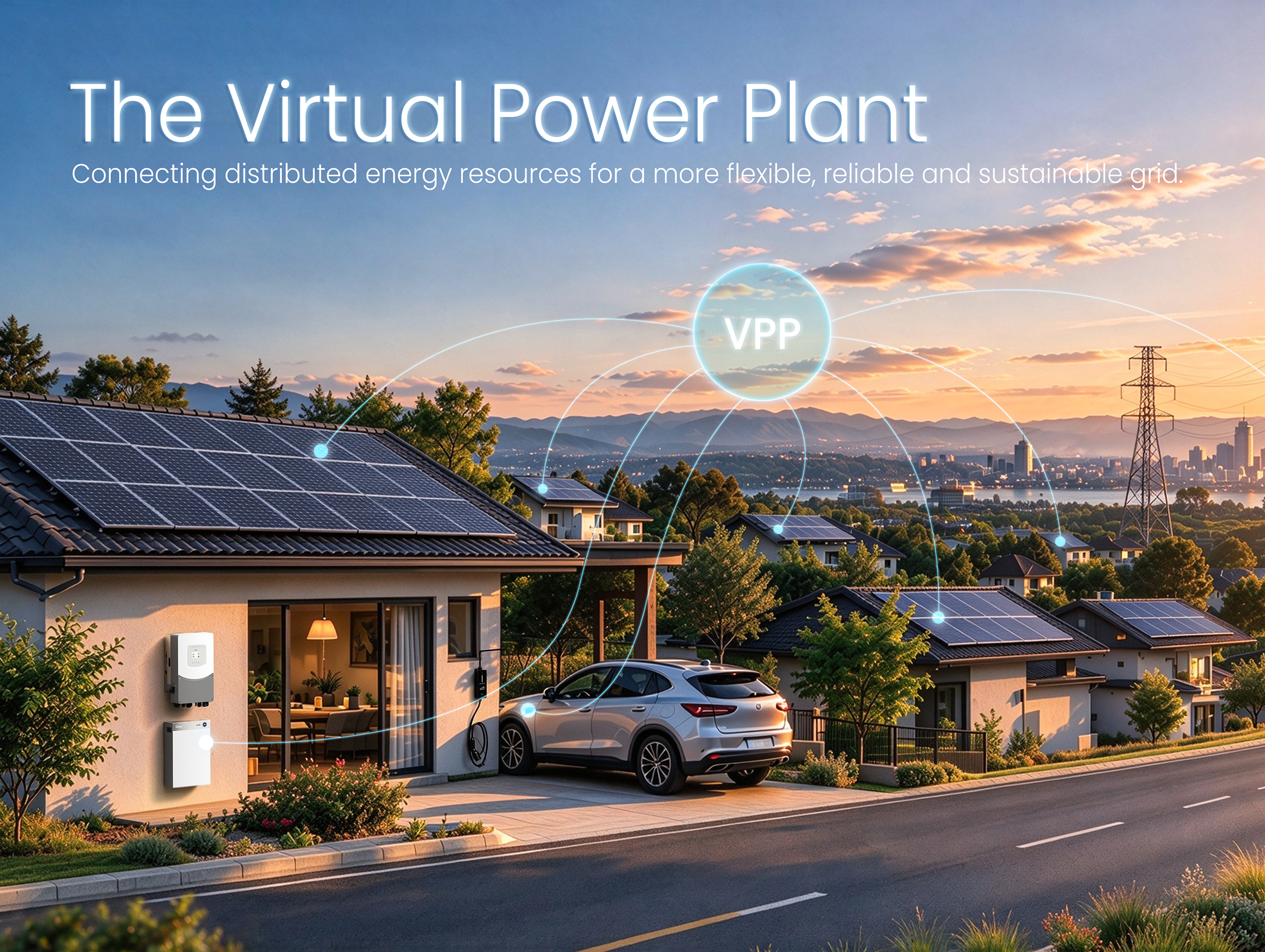 From Centralized Grids to Virtual Power Plants: The Next Evolution of the Power System
For more than a century, power systems around the world have relied on a centralized model. Large p...
-
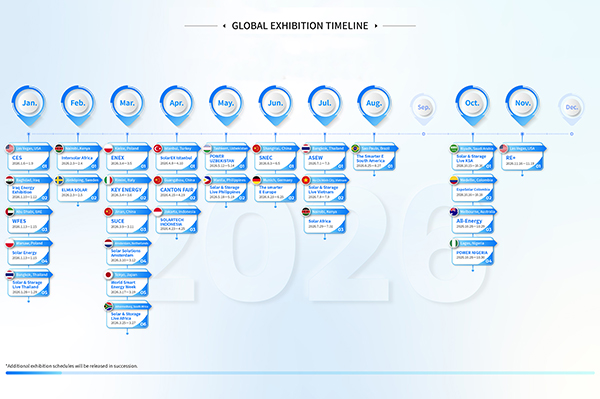 GLOBAL EXHIBITION TIMELINE
*Click to view larger image
-
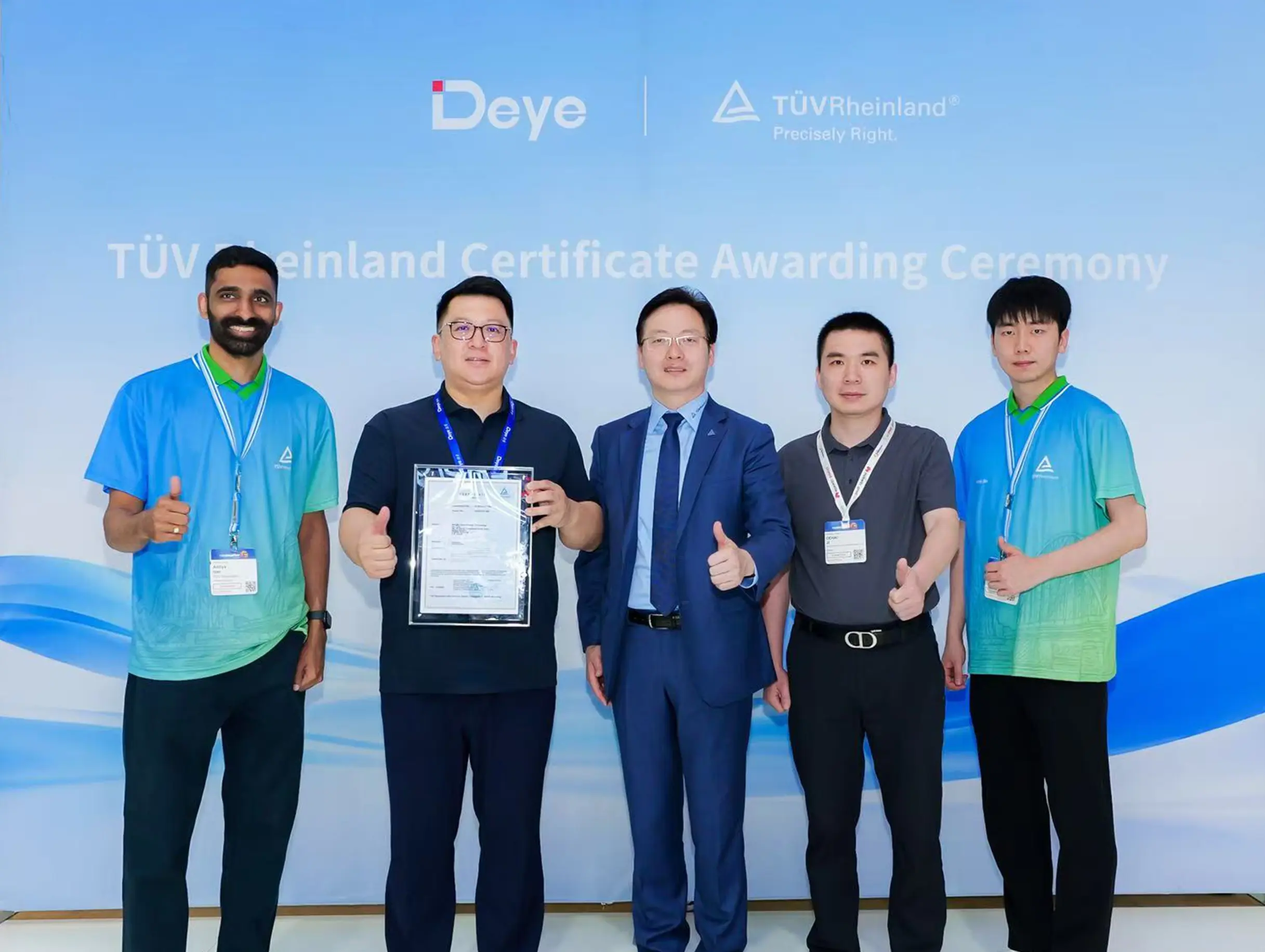 Deye Secures Multiple TÜV Rheinland Certifications at The smarter E Europe
On June 23, the opening day of The smarter E Europe 2026, Deye was officially awarded several presti...

Copyright@ 2024.Ningbo Deye Inverter Technology Co.,Ltd. All rights reserved. Solar Inverter Manufacturer
