
 Online Shop
 English
 China - 简体中文
 Global - English
 Brazil - Português
 Netherlands - Dutch
 Italy - Italiano
 Germany - Deutsch
 Spain - Español
 France - Français
 Vietnam - Tiếng Việt
 Poland - Polski
 Australia - English
 Japan - 日本語
Bai Shuying — After-Sales Support Supervisor, Solar Inverter Products
Smart Plug for Intelligent Solar Load Control and Energy Monitoring
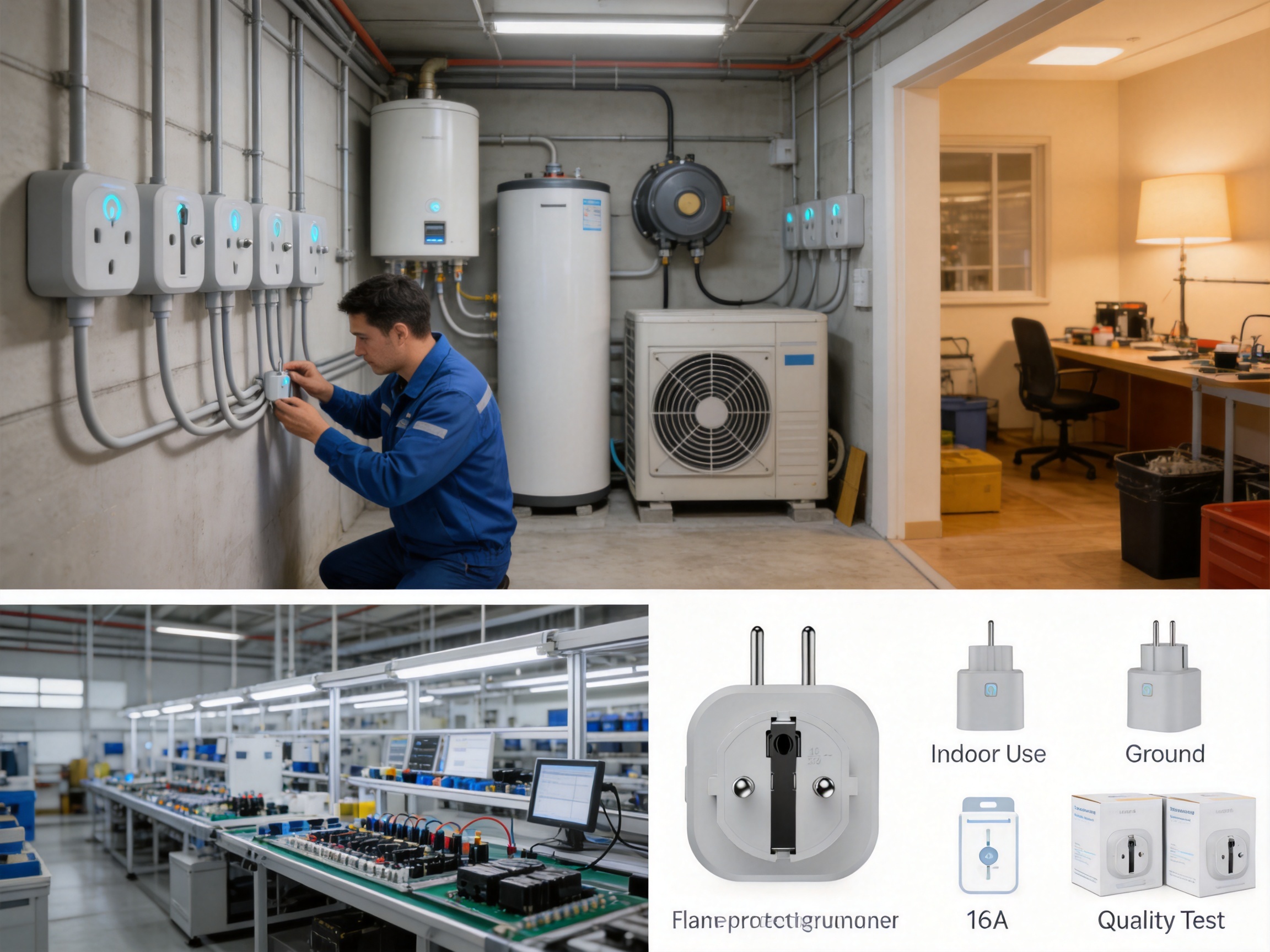
Modern solar energy systems are no longer limited to producing electricity. Homeowners and small businesses increasingly want to decide when appliances operate, how much energy they consume, and whether a load should remain active during a grid outage. A smart plug designed for solar and energy-storage applications can connect ordinary electrical equipment to this wider energy-management strategy.
The SUN-SMART-PLUG01-F is a plug-type smart control and monitoring device developed for this purpose. It provides a practical way to upgrade selected loads without replacing the connected appliance or redesigning the entire electrical installation. By combining LoRa wireless communication, real-time power monitoring, remote control, scheduling, and multiple electrical safeguards, the device helps transform individual appliances into controllable elements of a residential or small commercial energy system.
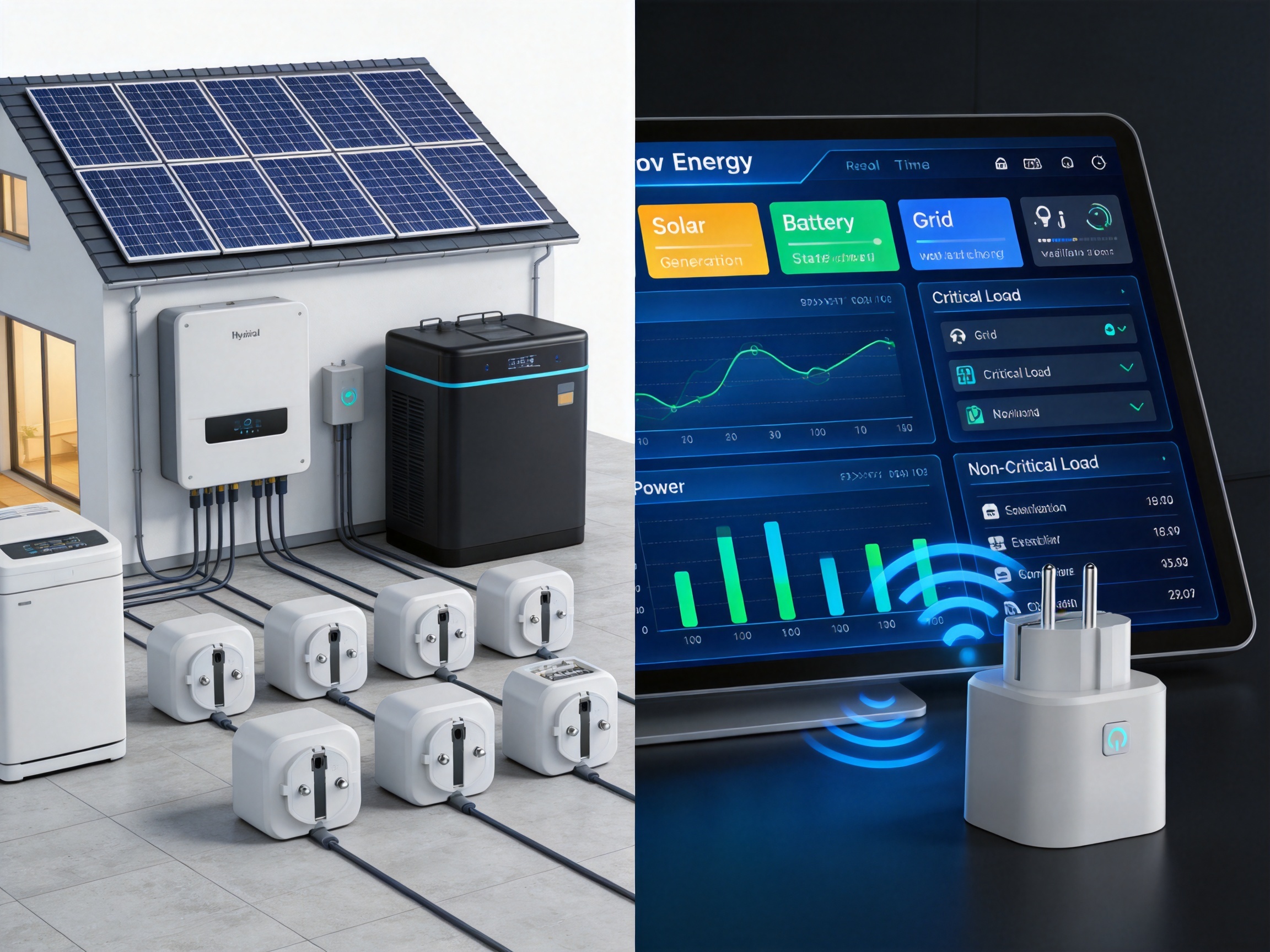
Its value is particularly clear when it is used together with photovoltaic generation, a hybrid inverter, a battery, and a cloud-based monitoring platform. Users can define critical and non-critical loads, create operating strategies based on time or battery state of charge, and respond to grid conditions. At the same time, the plug retains a compact form factor, simple plug-in installation, and a rated current of up to 16A a.c.
This article examines the product’s design, technical performance, application value, safety features, communication architecture, manufacturing strengths, and advantages compared with conventional timers, basic remote sockets, and other wireless load-control products.
1. The Role of a Smart Plug in a Solar Energy System
Solar electricity is variable. Photovoltaic output changes with sunlight, weather, season, and shading. Battery capacity is also limited, and electricity tariffs may vary according to time of day. These conditions create an opportunity for intelligent load control. Instead of operating every appliance according to a fixed routine, a smart energy system can coordinate loads with generation, storage, and grid availability.
A conventional appliance generally has only two states: on or off. It does not know whether solar power is available, whether the battery is nearly empty, or whether the grid is experiencing an interruption. A smart plug provides an interface between that appliance and the energy-management system. It can allow a user or an automated strategy to control the appliance according to practical energy conditions.
For example, a non-critical water heater, circulation pump, dehumidifier, workshop tool, or auxiliary appliance can be scheduled to operate during periods of strong solar production. If the battery state of charge falls below a configured level, the load can be turned off to preserve stored energy for essential equipment. If the grid becomes unavailable, non-critical devices can be disconnected while critical loads remain prioritized.
This approach offers a more flexible alternative to treating the entire building as one undifferentiated electrical load. It enables load-level management while preserving the original appliance and its existing plug connection.
2. Product Overview
The SUN-SMART-PLUG01-F belongs to the Accessory & Monitoring category. It is a plug-type device intended for direct insertion between a wall outlet and a connected appliance. The product is rated for 220–250V a.c. and a maximum current of 16A a.c., with support for 50Hz and 60Hz electrical systems within the specified frequency ranges.
The device uses LoRa communication rather than relying solely on a local Wi-Fi network. Its specified communication distance is approximately 200 meters in a barrier-free environment. This long-range wireless capability can be useful in houses, garages, workshops, outbuildings, and other areas where a conventional wireless network may not provide consistent coverage.
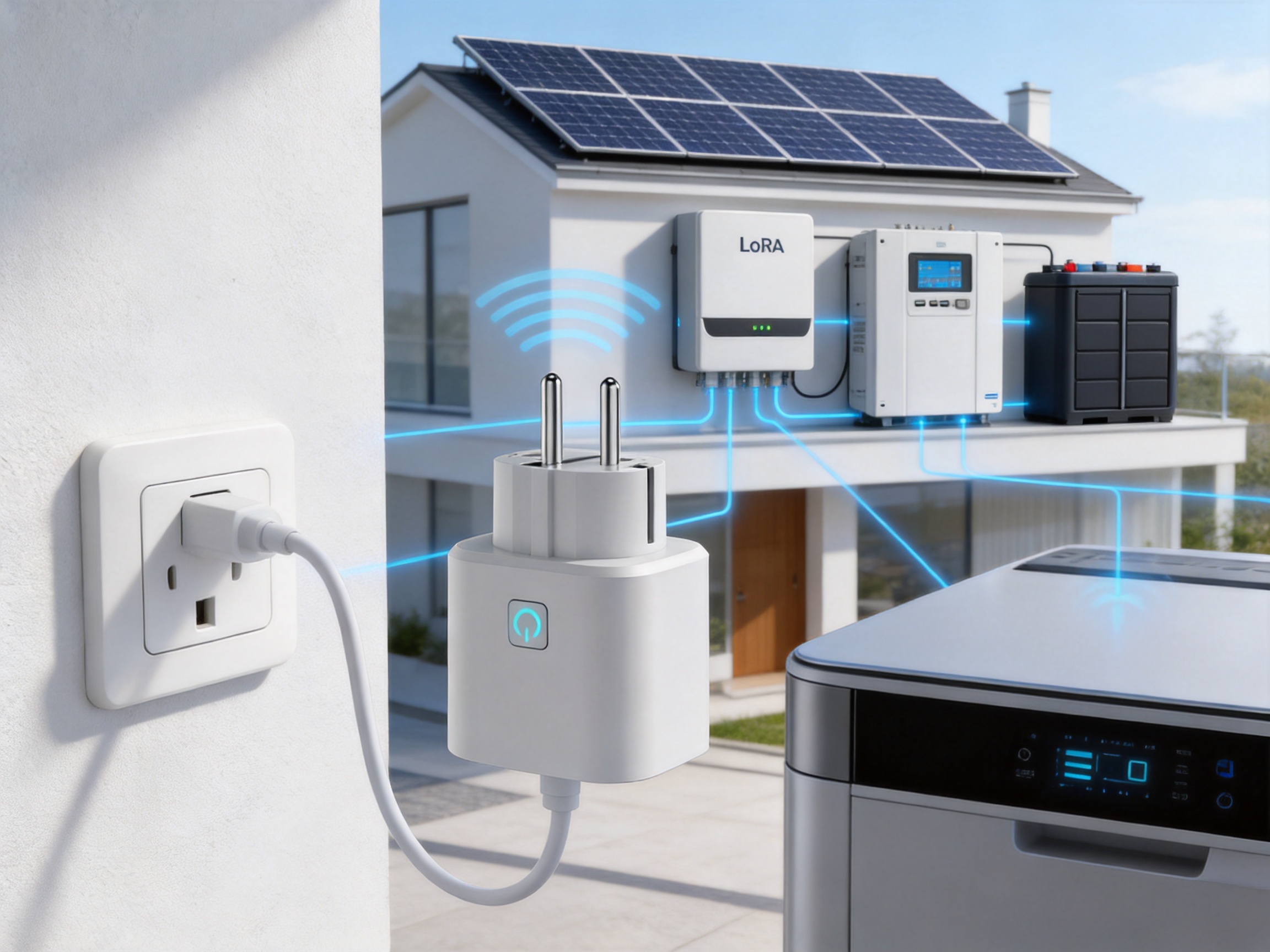
The product also supports real-time power monitoring and control through Deye Cloud. This allows the smart plug to become part of a broader energy-management environment rather than functioning only as an independent remote switch. Users can monitor the connected load, establish operating rules, and use energy information to make more informed decisions.
Key product functions include low-latency operation, long-range communication, offline operation, time-based strategies, state-of-charge-based strategies, grid-status-based strategies, critical-load and non-critical-load definition, and electrical protection. The flame-retardant housing and Class I protection design further support use in ordinary indoor electrical environments.
Core Specifications
| Model | SUN-SMART-PLUG01-F |
| Product category | Accessory & Monitoring |
| Rated voltage | 220–250V a.c. |
| Maximum current | 16A a.c. |
| Frequency | 50Hz: 45–55Hz; 60Hz: 55–65Hz |
| Connection | Plug-type |
| Communication technology | LoRa |
| Communication distance | Approximately 200m, barrier-free |
| Working temperature | -40°C to +60°C |
| Allowable environmental humidity | 0–95%RH |
| Ingress protection | IP20 |
| Protection level | Class I |
| Allowable altitude | Up to 3000m |
| Product dimensions | 51.2 × 51.2 × 64mm |
| Weight | 0.08kg |
| Warranty | 5 years |
| Wireless frequency range | 863–870MHz |
| Antenna | Internal antenna |
| Applicable standards | VDE 0620-2-1; EN 61058 |
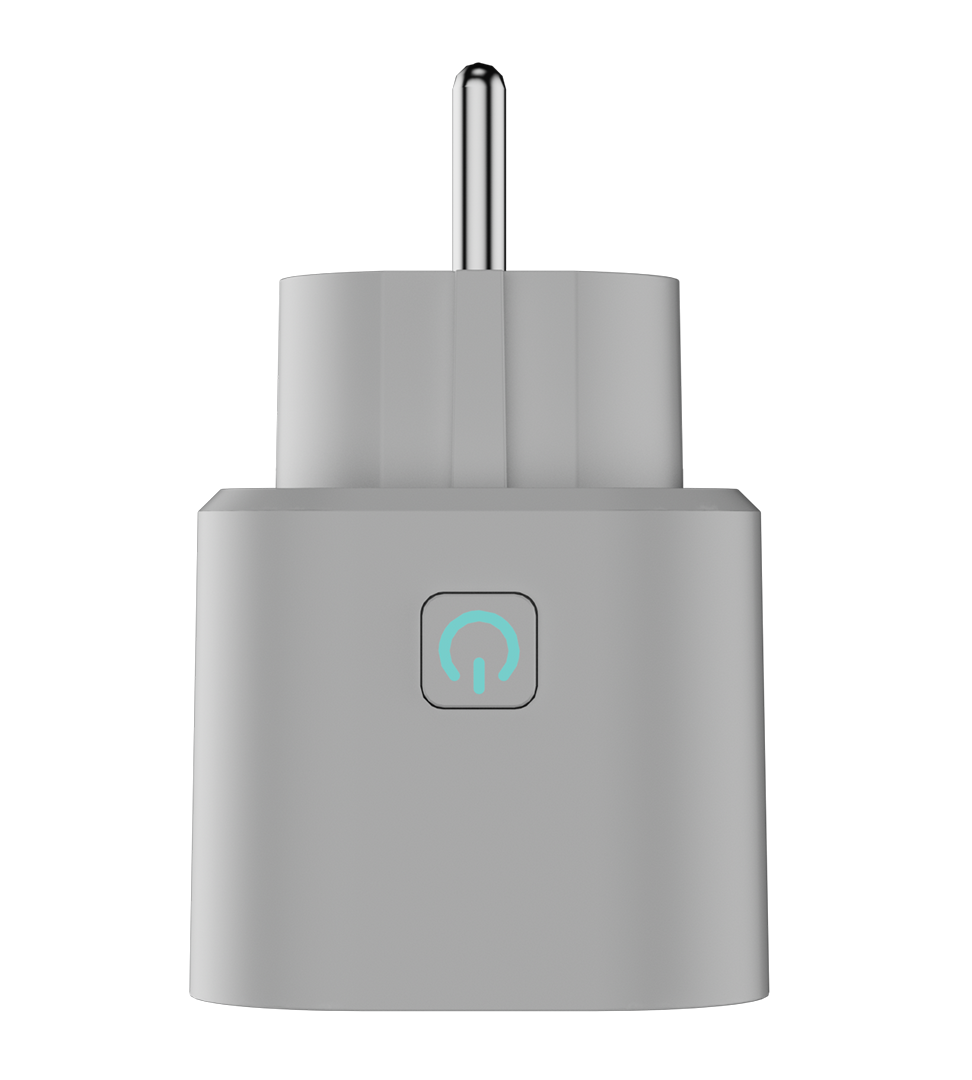
Smart Plug
3. Low-Latency Control for Practical Energy Management
In an energy-management application, communication speed affects how effectively a system responds to changing conditions. A delayed command may allow a non-critical load to continue operating after the battery has reached a reserve threshold, or it may prevent a solar-powered appliance from starting during a short period of available generation.
The smart plug is designed for low-latency operation. This characteristic supports responsive switching and monitoring between the energy-management system and the connected appliance. Low-latency communication is especially useful when several operating conditions are combined, such as a time schedule together with a battery state-of-charge limit and a grid-status rule.
For example, a user may configure a plug to operate an appliance between late morning and mid-afternoon, provided that the battery remains above a defined reserve. If the grid fails or the battery falls below that reserve, the system can issue a control command without depending on a slow manual response. The result is a more coordinated relationship between the appliance and the energy system.
Compared with a basic mechanical timer, the smart plug can respond to real energy conditions rather than following a fixed schedule. Compared with a simple remote-control socket, it can participate in a wider energy strategy based on generation, storage, and grid information.
4. Long-Range LoRa Communication
Wireless range is a significant consideration when smart devices are installed throughout a building. Wi-Fi signals can be weakened by reinforced concrete, metal structures, thick walls, distance, or the location of the router. Bluetooth is generally intended for shorter-range communication. Cellular communication can provide wide-area connectivity, but it may increase system complexity and operating costs.
The SUN-SMART-PLUG01-F uses LoRa communication in the 863–870MHz frequency range. Its specified range is approximately 200 meters without barriers. This makes the product suitable for many residential and light commercial layouts, including detached garages, storage areas, utility rooms, workshops, and garden buildings, provided that the actual installation environment is evaluated.
LoRa technology is well suited to control and monitoring applications that require reliable communication over a relatively long distance while transmitting modest amounts of data. A smart plug does not need to stream video or transfer large files. It needs to send measurements, receive commands, and report operating status. The communication requirements therefore match the strengths of a low-power, long-range protocol.
The internal antenna contributes to the compact design by avoiding an external antenna that could be damaged, obstructed, or inconveniently positioned. The product’s small dimensions allow it to be installed without occupying excessive space around the wall outlet.
Actual communication performance can vary according to walls, building materials, electromagnetic conditions, installation height, and the position of the gateway or associated equipment. The stated distance should therefore be understood as a barrier-free reference value rather than a guarantee for every building.
5. Offline Operation and System Resilience
Cloud connectivity provides valuable remote access, but a smart energy product should not become useless whenever an external internet connection is interrupted. The product’s offline operation capability addresses this concern by allowing certain control functions to continue locally or through the associated local communication architecture, depending on the system configuration.
Offline operation is important for several reasons. First, appliances may need to follow a previously established strategy even when the internet is temporarily unavailable. Second, local control can reduce dependence on external communication services. Third, a building’s electrical loads should remain manageable during network interruptions, especially when those interruptions are unrelated to the electrical supply itself.
For example, an operator may configure a recurring time strategy for a ventilation fan or water-heating device. If the internet connection temporarily fails, continued local execution of the strategy can prevent the appliance from remaining permanently on or off. In a solar-plus-storage installation, this helps preserve the practical value of automation.
Offline capability also distinguishes the product from simple cloud-dependent devices. A consumer smart socket that requires an internet connection for every command may be convenient under normal conditions but less dependable in a resilient energy system. The smart plug’s ability to support offline operation is therefore an important system-level advantage.
6. Strategies Based on Time, Battery State, and Grid Status
One of the product’s strongest features is the ability to support custom strategies based on time, state of charge, and grid status. These conditions reflect the main operating variables of a modern solar and energy-storage system.
Time-Based Strategies
Time-based control is the simplest form of energy scheduling. A user can define periods during which a load is permitted or instructed to operate. This can be useful for appliances with predictable usage patterns, such as water heaters, pool pumps, irrigation equipment, ventilation systems, and workshop equipment.
Time strategies can also help users take advantage of electricity tariffs. If electricity is less expensive during certain hours, a connected load can be scheduled for that period. When combined with photovoltaic production, the schedule can prioritize daylight operation and reduce energy drawn from the grid.
State-of-Charge Strategies
A battery state-of-charge strategy links load operation to the amount of stored energy available. A user may define a minimum reserve level below which non-critical appliances should be disconnected. Conversely, a high state-of-charge condition may permit additional loads to operate.
This function is valuable because not all electrical loads have the same importance. Refrigeration, communication equipment, medical equipment, and selected lighting may be considered critical. A decorative appliance, water heater, or workshop tool may be non-critical. The smart plug allows users to make this distinction at the load level.
Grid-Status Strategies
Grid-status control can help coordinate appliances during normal grid operation, grid outages, or other defined system conditions. If the grid fails, non-critical loads can be turned off to reduce demand on the battery and maintain power for essential circuits. When normal grid operation returns, the system can restore selected loads according to the configured strategy.
This is particularly relevant to hybrid inverter systems. The inverter may supply backup power to a designated load area, but the total available battery energy remains limited. Smart load control provides an additional layer of prioritization, helping users manage which appliances are allowed to operate during backup conditions.
Combined Strategies
The most useful applications often combine multiple conditions. A user could configure an appliance to run only during daylight hours, only when the battery state of charge is above a selected threshold, and only while the grid is available. Another strategy could permit operation when the battery is highly charged, regardless of the exact time, while disconnecting the load during a grid outage.
These combinations provide more flexibility than fixed timers and more energy awareness than basic remote-control sockets. They also allow the system to adapt to changing household routines and seasonal solar conditions.
7. Real-Time Monitoring Through a Cloud Platform
Control is more effective when it is supported by measurement. The smart plug provides real-time power monitoring and control through Deye Cloud, allowing users to view the connected load and make decisions based on actual consumption.
Real-time monitoring can reveal which appliances consume the most electricity, how long they operate, and whether their use coincides with solar generation. This information can help users adjust schedules, identify unnecessary consumption, and understand the effect of individual appliances on household energy performance.
For installers and system operators, monitoring can simplify the review of connected loads. Instead of relying only on estimates, an operator can examine measured behavior and determine whether a strategy is working as intended. This may assist with commissioning, troubleshooting, and customer education.
Cloud-based control also supports remote access. A user may review status or change a strategy without being physically present at the installation. This is useful for vacation homes, rental properties, small offices, agricultural buildings, and distributed equipment.
Cloud functions do not eliminate the importance of local operation. The strongest architecture combines remote visibility with dependable local behavior. In this respect, the product’s cloud integration and offline operation capabilities complement one another rather than serving as substitutes.
8. Defining Critical and Non-Critical Loads
Load prioritization is a central concept in backup power and energy storage. During normal grid operation, many appliances can run without difficulty. During an outage, however, the battery and inverter may need to supply only the loads that matter most.
The smart plug makes it easier to define a load as critical or non-critical within an energy-management strategy. This distinction does not necessarily change the appliance itself. Instead, it changes the conditions under which the appliance is permitted to consume energy.
Critical loads may include refrigeration, selected lighting, networking equipment, security systems, medical-support devices, or other appliances that users want to preserve during a power interruption. Non-critical loads may include water heating, entertainment equipment, workshop tools, decorative lighting, and other flexible consumers.
By controlling non-critical loads separately, users can make better use of stored energy. The battery does not need to support every appliance simultaneously, and the inverter can focus on essential consumption. This can improve the practical experience of backup power without requiring every load to be rewired into a complicated control system.
Load classification should always be carried out by a qualified installer where electrical safety or backup operation is involved. The smart plug is a control and monitoring accessory; it should not be used to exceed the ratings of the electrical circuit, wall outlet, appliance, or upstream protective devices.
9. Electrical Safety and Protective Design
Because the smart plug is installed in the path of an a.c. electrical load, safety is fundamental. The product includes Class I protection and multiple electrical safeguards. Its housing is made with flame-retardant material, and the device is designed according to the stated VDE 0620-2-1 and EN 61058 standards.
The maximum current rating is 16A a.c. at a rated voltage of 220–250V a.c. This rating indicates the electrical operating limit of the product, but it does not mean that every appliance drawing up to 16A is automatically suitable. The connected appliance should have an appropriate plug, load profile, inrush characteristic, and operating environment.
Motors, compressors, heaters, and other appliances may produce starting currents or switching behavior that differs from their normal running current. Users should confirm compatibility before connecting such loads. Where an appliance has a high inrush current or unusual duty cycle, professional assessment is recommended.
The IP20 rating indicates that the product is intended for indoor environments protected from water and does not provide protection against dust ingress comparable to higher IP classifications. It should not be installed outdoors, in wet areas, or in locations exposed to splashing water unless the complete installation provides suitable environmental protection.
The specified operating temperature range is -40°C to +60°C, and allowable environmental humidity is 0–95%RH. These values describe the product’s stated environmental capability, but condensation, direct water exposure, extreme heat, and poor ventilation should still be avoided. The allowable altitude is up to 3000 meters.
Safety is one area where a purpose-built energy accessory can offer an advantage over unverified low-cost smart sockets. Products intended for integration into a structured energy system should be selected according to electrical ratings, applicable standards, environmental conditions, and system compatibility rather than purchase price alone.
10. Compact Form Factor and Plug-In Installation
The device measures 51.2 × 51.2 × 64mm and weighs approximately 0.08kg. This compact and lightweight construction makes it practical for plug-in installation near ordinary appliances. Users can upgrade a suitable appliance without replacing the appliance’s internal control electronics or adding a separate wall-mounted enclosure.
Plug-in installation reduces the amount of electrical work required compared with permanently wired load-control equipment. For suitable applications, the installer or user can insert the smart plug into an approved wall outlet and connect the appliance to the device. Configuration and pairing can then be completed through the associated energy-management system.
This simplicity is a major advantage over solutions that require extensive rewiring, additional contactors, or a dedicated control cabinet for every small load. It can reduce installation time and make load-level management accessible to more residential users.
At the same time, plug-in simplicity should not be confused with unlimited application flexibility. The wall outlet, circuit protection, plug standard, appliance current, and local electrical regulations must all be appropriate. A device with a compact housing still requires correct installation and responsible use.
11. Comparison with Conventional Alternatives
Mechanical Timers
Mechanical timers are inexpensive and easy to understand, but they normally follow a fixed schedule. They do not measure the connected load, respond to battery state of charge, recognize grid status, or adapt automatically to changes in solar production.
The smart plug provides a more advanced alternative by connecting time schedules with real energy conditions. A user can still benefit from scheduled operation, but the schedule can be made more intelligent through state-of-charge and grid-status rules.
Basic Wi-Fi Sockets
Basic Wi-Fi sockets often provide remote switching through a mobile application. They can be useful for simple household automation, but their performance may depend on router coverage, internet access, and cloud service availability. They may also lack direct integration with inverter and battery information.
The SUN-SMART-PLUG01-F is designed specifically for an energy-management environment. Its LoRa communication, approximately 200-meter barrier-free range, offline operation, and support for solar and storage strategies provide a more specialized solution for energy control.
Bluetooth-Controlled Devices
Bluetooth products can be convenient for nearby control, but their communication distance is generally more limited. They may not be suitable for an appliance located in a separate building or at the far end of a large property.
Long-range LoRa communication gives the smart plug a stronger position in distributed residential and small commercial layouts, particularly where the wireless path is longer than a typical room-to-room connection.
Permanent Wired Control Systems
Permanently wired control systems can offer powerful switching capabilities, but they often require more installation work, additional space, and greater project planning. They may be appropriate for large loads or new construction, but they can be excessive for a single flexible appliance.
The plug-in design provides a lower-complexity option for selected loads. It is especially useful when the objective is to improve energy management without modifying the building’s fixed wiring extensively.
Unintegrated Energy Monitors
Some monitors provide consumption data but do not control the connected load. Others provide switching but lack meaningful measurement. The smart plug combines monitoring and control, allowing users to observe the result of an operating strategy rather than simply issue commands without feedback.
12. Manufacturing Strength and Product Development Capability
The product is backed by Ningbo Deye Inverter Technology Co., Ltd., a technology manufacturing enterprise integrating research and development, design, production, sales, and service. Founded in 2000, the company has developed experience across photovoltaic inverters, energy-storage systems, environmental appliances, and energy-related digital platforms.
This broad product background is relevant to the smart plug because the device is not an isolated consumer accessory. Its purpose is to communicate with and support a wider solar and storage ecosystem. Experience in inverter and energy-storage development can help inform the requirements for load control, battery-aware operation, grid-status logic, communication reliability, and system-level compatibility.
The company’s product portfolio includes string inverters, energy-storage inverters, microinverters, residential energy-storage systems, commercial and industrial battery solutions, modular energy-storage systems, electric-vehicle charging solutions, and related monitoring technologies. This range creates an engineering environment in which accessories can be developed with a clearer understanding of the complete energy chain.
Advanced manufacturing strength is not limited to the physical assembly of a small plug. It includes product specification, electrical design, firmware development, communication integration, protection design, quality control, compatibility testing, and after-sales support. A smart plug must perform reliably as both an electrical device and a networked energy-management component.
Integrated Research and Development
Research and development capability supports the creation of products that combine power electronics, wireless communication, software, and user interfaces. For the smart plug, these disciplines must work together. A reliable device must accurately measure power, receive and process commands, maintain suitable communication behavior, and operate safely within its electrical limits.
The company’s experience in photovoltaic and energy-storage products provides a foundation for developing control logic related to battery state of charge and grid conditions. This is a stronger starting point than designing a general-purpose socket without a direct relationship to solar generation or energy storage.
Manufacturing and Quality Processes
A dependable smart plug requires consistent production of its enclosure, electrical contacts, protection components, communication module, internal antenna, and control electronics. Manufacturing quality affects not only appearance but also contact resistance, thermal behavior, mechanical strength, measurement accuracy, and long-term reliability.
Integrated manufacturing capability can support coordinated control over component selection, assembly procedures, inspection, functional testing, and final product verification. It also allows engineering feedback from production to be incorporated into later design improvements.
The flame-retardant housing, Class I protection, stated product standards, and five-year warranty demonstrate that durability and safety are important parts of the product proposition. The warranty does not eliminate the need for correct use, but it provides additional confidence for users and installers selecting a product for long-term energy-management applications.
System-Level Compatibility
A smart accessory is more valuable when it works naturally with the inverter, battery, cloud platform, and monitoring tools already used by the customer. The product’s Deye Cloud integration and LoRa communication are intended to support this system-level relationship.
System integration can simplify commissioning and operation. Instead of managing an inverter through one platform and a separate smart socket through another, users may be able to coordinate the relevant devices within a unified environment. This can reduce confusion and make energy strategies easier to understand.
13. Application Scenarios
Residential Solar and Battery Systems
In a home equipped with photovoltaic panels and battery storage, the smart plug can control appliances whose operating time is flexible. Examples include water-heating equipment, dehumidifiers, circulation pumps, selected lighting, entertainment devices, and small workshop tools.
During the day, a solar-priority strategy can allow the appliance to consume available photovoltaic energy. When solar output decreases, the system can stop the load or permit it to operate only when the battery remains above a reserve level.
Backup Power Management
During a grid outage, the smart plug can help disconnect non-critical loads so that stored energy is reserved for essential equipment. This can be especially useful in homes where the backup system supplies a group of circuits that includes both essential and flexible appliances.
Garages and Outbuildings
The long-range LoRa communication capability makes the product suitable for appliances located away from the main living area. A garage heater, pump, ventilation fan, or workshop device may be difficult to control reliably using short-range wireless communication, while a wired control solution may be inconvenient.
Small Offices and Commercial Premises
Small offices can use the device to manage printers, auxiliary equipment, water dispensers, ventilation devices, and other flexible loads. Time-based schedules can reduce unnecessary operation outside working hours, while real-time monitoring can help identify equipment that consumes energy when it should be inactive.
Rental Properties and Holiday Homes
Remote monitoring and control can help property owners manage appliances when they are not on site. Strategies can be adjusted according to occupancy, seasonal conditions, or energy availability. Offline operation can provide additional resilience when the local internet connection is temporarily unavailable.
14. Installation and Configuration Considerations
Before installation, the connected appliance should be checked against the product’s rated voltage, current, frequency, plug type, and environmental requirements. The maximum current is 16A a.c., but the appliance’s starting current and duty cycle should also be considered.
The smart plug is rated IP20 and is therefore intended for indoor, dry locations. It should be kept away from rain, splashing water, condensation, excessive dust, and sources of direct heat. The outlet should be properly installed, grounded where required, and protected by suitable upstream electrical protection.
The communication path should be evaluated before final placement. The approximately 200-meter distance is specified for a barrier-free environment. Concrete walls, metal cabinets, underground locations, and other obstructions can reduce the practical range. Where possible, the associated communication equipment should be positioned to provide a clear and stable wireless path.
After installation, the device should be paired with the energy-management system and checked for correct measurement, switching response, and status reporting. Test procedures should include normal operation, scheduled operation, battery state-of-charge conditions, grid-status changes, and recovery after communication interruptions.
Users should begin with conservative settings. A load can first be monitored without an aggressive automation rule, allowing its normal consumption and operating behavior to be understood. Strategies can then be introduced gradually, with priority given to safety and the preservation of critical loads.
15. Operational Benefits for Users and Installers
For end users, the most visible benefit is convenience. A suitable appliance can receive an immediate smart upgrade simply by being connected through the plug. The user does not need to replace the appliance or install a large control system for every flexible load.
The second benefit is energy awareness. Real-time monitoring helps users understand where electricity is being consumed. This knowledge can encourage better habits and support more effective use of solar generation and battery storage.
The third benefit is resilience. By controlling non-critical loads during grid outages or low-battery conditions, the system can focus available energy on priority appliances.
For installers, the plug-in design can simplify deployment in suitable locations. The product’s integration with a broader inverter and cloud ecosystem may reduce the need to combine unrelated control platforms. Long-range communication can also make installation more practical in buildings where short-range wireless signals are unreliable.
For system designers, the product creates another control layer between energy production and end-use consumption. This can support more sophisticated residential and small commercial energy-management packages without requiring every appliance to contain dedicated smart electronics.
16. Limitations and Responsible Use
A clear understanding of the product’s limitations is essential. The smart plug is not a replacement for a circuit breaker, residual-current device, electrical distribution board, or professional backup-transfer system. It should not be used to create a safety-critical electrical arrangement without appropriate engineering review.
Its IP20 rating limits it to suitable indoor locations. Its 16A maximum current rating limits the connected load. Its communication distance depends on the actual installation environment. Its automation behavior depends on correct configuration of the associated energy-management system.
The product should not be overloaded or connected to an appliance whose current, inrush, heat generation, or environmental conditions exceed the design assumptions. If the plug becomes unusually hot, emits an odor, shows physical damage, or operates irregularly, it should be disconnected safely and inspected by a qualified professional.
Users should also consider the operating behavior of appliances that must not be switched off unexpectedly. Some equipment may require a controlled shutdown procedure. Critical medical or safety equipment should not depend solely on a plug-level automation device unless the complete system has been professionally designed for that purpose.
17. Why the Product Stands Out in a Competitive Market
The smart-plug market includes many inexpensive products designed primarily for household convenience. The SUN-SMART-PLUG01-F is differentiated by its closer relationship with photovoltaic and energy-storage applications.
Its first competitive advantage is energy-system awareness. Time, battery state of charge, and grid status provide more meaningful control conditions than a simple on/off command or fixed schedule.
Its second advantage is communication range. LoRa communication and an approximately 200-meter barrier-free distance can provide broader coverage than many short-range consumer devices.
Its third advantage is offline operation. Continued local behavior during an internet interruption improves resilience and reduces dependence on permanent cloud connectivity.
Its fourth advantage is the combination of monitoring and control. Users can see real-time power behavior and use that information to refine operating strategies.
Its fifth advantage is ecosystem integration. A smart plug connected to a platform that also manages solar inverters, batteries, and energy data can be easier to operate than several disconnected products.
Its sixth advantage is product support from a manufacturer with extensive experience in photovoltaic inverters, energy-storage systems, and energy IoT development. This background supports a more complete approach to compatibility, system design, and long-term service.
These advantages do not mean that the product is suitable for every application. A permanent industrial control system may be preferable for high-power loads, and a basic timer may be adequate for a simple low-risk schedule. The product’s strength lies in the middle ground: intelligent, solar-aware control for suitable plug-connected loads without the complexity of a full wired automation installation.
18. Future Potential for Smart Load Control
As distributed energy systems become more common, the ability to control flexible demand will become increasingly important. More households and businesses are installing solar panels, batteries, electric-vehicle chargers, heat pumps, and other equipment that can affect the timing and size of electricity consumption.
Smart plugs can provide a practical entry point into this wider demand-management structure. They allow existing appliances to participate in energy strategies before users invest in more extensive building automation.
Future applications may involve more detailed coordination among photovoltaic production, battery state of charge, electricity tariffs, weather forecasts, electric-vehicle charging, and appliance priorities. A product that already supports time, state-of-charge, grid-status, cloud, and offline functions provides a foundation for this development.
Manufacturers with experience across inverters, batteries, monitoring platforms, and communication technologies are well positioned to create these integrated solutions. The ability to connect hardware, software, and energy-management logic will be an important competitive factor as the market develops.
19. Frequently Asked Questions
What is the primary purpose of the smart plug?
The primary purpose is to provide intelligent monitoring and control for a suitable plug-connected appliance. It can help coordinate that appliance with solar generation, battery storage, time schedules, and grid conditions.
What is the maximum rated current?
The maximum rated current is 16A a.c. at a rated voltage of 220–250V a.c. The complete electrical installation and connected appliance must also be suitable for the load.
What communication technology does the product use?
The product uses LoRa communication in the specified 863–870MHz frequency range. The stated communication distance is approximately 200 meters in a barrier-free environment.
Can the smart plug work without an internet connection?
The product supports offline operation. The exact functions available during an internet interruption depend on the system configuration, but the offline capability is intended to support continued local energy-management behavior.
Can it monitor power consumption?
Yes. The product supports real-time power monitoring and control through Deye Cloud, allowing users to review the connected load and manage its operation.
What types of loads can be controlled?
Suitable examples include flexible residential and small commercial loads such as water-heating equipment, pumps, ventilation devices, dehumidifiers, workshop tools, and selected auxiliary appliances. The load must comply with the voltage, current, frequency, plug, environmental, and switching requirements of the complete installation.
Can it control a load during a power outage?
It can support grid-status-based strategies in a compatible energy-management system. This can allow non-critical loads to be disconnected during an outage so that battery energy is reserved for critical equipment.
Is the product suitable for outdoor use?
The product has an IP20 rating and is intended for appropriate indoor environments. It should be protected from rain, splashing water, condensation, and other conditions that exceed its environmental design.
Does it replace circuit protection?
No. It is an accessory for monitoring and control, not a replacement for circuit breakers, residual-current protection, grounding systems, or other required electrical safety equipment.
What does Class I protection mean for the product?
Class I protection indicates a protective grounding arrangement as part of the product’s safety design. The product must be used with an electrical installation that provides the required protective connection.
What is the warranty period?
The stated warranty period is five years, subject to the manufacturer’s warranty terms and correct installation and use.
How does it compare with a mechanical timer?
A mechanical timer generally follows a fixed schedule. The smart plug can support more advanced strategies based on time, battery state of charge, and grid status, while also providing monitoring and remote control.
How should the communication distance be interpreted?
The approximately 200-meter specification is a barrier-free reference value. Walls, metal structures, concrete, interference, and the placement of communication equipment can reduce the actual distance.
Is professional installation required?
For straightforward plug-in use, installation may be simple, but electrical compatibility and system configuration must still be checked. Professional assistance is recommended for backup-power applications, unusual loads, commercial installations, and any situation involving electrical modifications.
20. Conclusion
The SUN-SMART-PLUG01-F provides a practical connection between ordinary electrical appliances and intelligent solar energy management. Its plug-in form makes it easy to deploy, while its LoRa communication, low-latency operation, long-range connectivity, offline capability, and cloud integration give it greater functionality than a conventional timer or basic remote socket.
The product is particularly valuable for flexible loads that can be scheduled, monitored, or disconnected according to energy conditions. By supporting strategies based on time, battery state of charge, and grid status, it helps users make a clearer distinction between critical and non-critical consumption.
Its Class I protection, flame-retardant housing, stated electrical standards, indoor-rated construction, and five-year warranty contribute to a product proposition focused on dependable long-term use. Correct installation remains essential, especially for high-current, motor-driven, heat-producing, or backup-power-related appliances.
The manufacturer’s broader experience in photovoltaic inverters, energy-storage systems, monitoring platforms, and energy IoT solutions strengthens the product’s position in the market. Rather than treating the smart plug as an isolated convenience device, the company develops it as part of a wider energy ecosystem.
For homeowners, installers, and small commercial operators seeking a manageable way to improve solar self-consumption, backup-load prioritization, and appliance-level visibility, the smart plug offers a balanced combination of simplicity, connectivity, control, and system integration.
References
1. Product Datasheet, SUN-SMART-PLUG01-F Smart Plug, English edition, 2026.
2. VDE 0620-2-1, Plugs and Socket-Outlets for Household and Similar Purposes.
3. EN 61058, Switches for Appliances.
4. Manufacturer Product Information, Accessory and Monitoring Solutions.
5. Manufacturer Corporate Information, Photovoltaic Inverters, Energy-Storage Systems, and Energy IoT Solutions.
6. General Principles of Residential Photovoltaic Self-Consumption and Battery-Based Load Management.
Product: Smart Plug
PREV:High-Efficiency Three-Phase String Inverter for Modern Commercial Solar Systems
NEXT:High-Performance Three-Phase String Inverters for Commercial Solar Plants
Share
Product recommendations
news recommendations
-
 From Centralized Grids to Virtual Power Plants: The Next Evolution of the Power System
For more than a century, power systems around the world have relied on a centralized model. Large p...
-
 GLOBAL EXHIBITION TIMELINE
*Click to view larger image
-
 Deye Secures Multiple TÜV Rheinland Certifications at The smarter E Europe
On June 23, the opening day of The smarter E Europe 2026, Deye was officially awarded several presti...

Copyright@ 2024.Ningbo Deye Inverter Technology Co.,Ltd. All rights reserved. Solar Inverter Manufacturer
